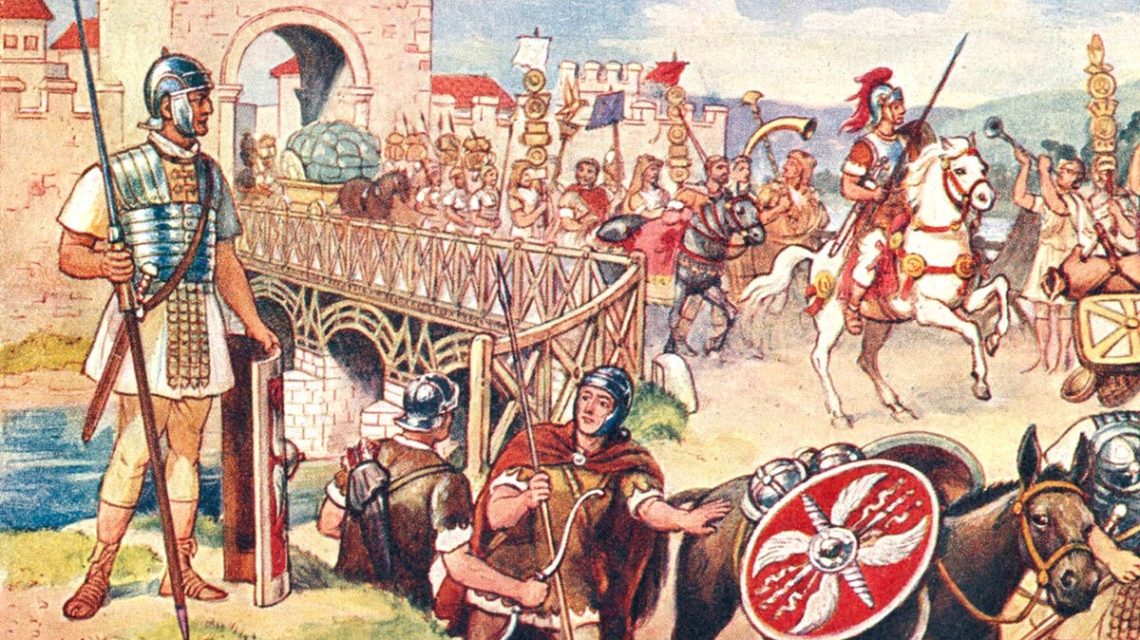
A recent comprehensive study of the Roman Empire’s extensive road network questions the classic saying, ‘All roads lead to Rome.’ Published on September 15 in the journal Nature Communications, the research examines around 190,000 miles of Roman roads that spread across Europe, the Middle East, and North Africa.
The research team compiled existing data to develop a new map of the Roman Empire’s roadways and analyzed their structure on a grand scale. Surprisingly, the study determined that Rome was not a uniquely central point in the empire’s road system. Provincial capitals also played crucial roles in overland travel.
Constantinople, now Istanbul, Turkey, emerged as a central hub for travel. This shift occurred after Emperor Constantine established it as the imperial capital in the fourth century A.D.
The saying, ‘All roads lead to Rome,’ may not entirely capture the historical truth.
Tom Brughmans, the lead researcher and a classical archaeologist at Aarhus University in Denmark, explained to Fox News Digital that the phrase is medieval in origin and should not be taken literally. For instance, none of the roads in Roman Britain directed toward Rome.
Brughmans stated that the saying has shaped popular perceptions of Roman roads but acknowledged that the study complicates this understanding. He prefers to say, ‘All roads lead to Rome and everywhere else.’
Taco Terpstra, a history and classics professor at Northwestern University, noted that while the findings do not lessen Rome’s significance, they present new perspectives. Terpstra highlighted that Constantinople only became a capital in the fourth century and was initially known as Byzantium, a small fishing town.
Terpstra affirmed that Rome remained central to imperial politics, military strategy, and ideology for centuries. With a population of a million inhabitants, Rome dwarfed other cities like Alexandria.
The study also highlighted Roman engineering, specifically the straightness of the roads. Despite challenging terrains, Roman roads were constructed as straight as possible given the available technology.
The roads primarily served military purposes, enabling rapid troop movement across conquered territories. Over time, they became vital for economic activity.
However, Terpstra emphasized that maritime routes were the Roman Empire’s main transportation networks, being more cost-effective for moving goods. Roman roads, though remarkable, were secondary to these sea routes.
 Tensions Rise in South China Sea After Ship Collision
  Where is Austin Tice?
  Trump’s Speech Targets Iran’s Nuclear Ambitions at U.N.
  U.S., Denmark, and Greenland Sign New Security Agreement
  U.S. Military Aircraft Crash at Spangdahlem Air Base
  Marco Rubio Criticizes NATO’s Role Amid Middle East Conflict