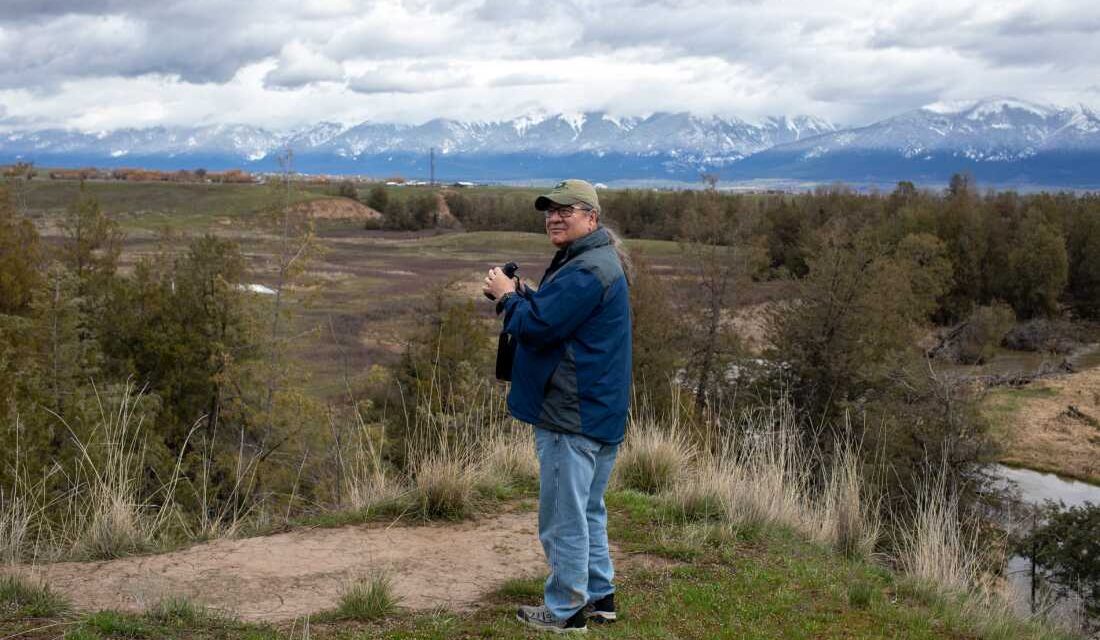
Mike Durglo Jr. has dedicated his life to preparing his community for climate change. As the climate change coordinator for the Confederated Salish and Kootenai Tribes, he wrote one of the country’s first tribal climate action plans over 15 years ago.
On a crisp April morning in Ronan, Montana, Durglo stood overlooking the Flathead Indian Reservation, home to his ancestors for centuries. He pointed out the mountains where his father taught him to track deer and to a distant peak with a lone whitebark pine, which he calls Ilawya, meaning “my great, great, great grandparent.” This ancient tree represents resilience amid change.
Like much of the west, Montana experienced a record-breaking warm spring with below-average snowpack. Warm temperatures, beetle outbreaks, and invasive fungus have killed half the whitebark pine population since the 1990s. Despite these challenges, the Tribes see the whitebark pine as a symbol of hope. They harvest cones from healthy trees to regrow seedlings resistant to the fungus, helping maintain snow on the landscape and preventing drought and wildfires.
At the Forestry Tribal Nursery, greenhouse manager Matthew Ogden inspects the seedlings. Durglo’s deep connection to this land drives his efforts to prepare it for a warming climate. Despite state and federal climate action challenges, the Tribes continue their work. Montana’s climate plan, abandoned under the current Republican governor, and federal funds cuts do not deter them.
As sovereign nations, tribes can push forward with climate initiatives. Durglo has secured funding from state governments, nonprofits, and federal agencies, creatively piecing resources together for climate work.
The Confederated Salish and Kootenai Tribes’ climate plan includes wind energy development, water conservation, and ecosystem restoration to prepare for longer wildfire seasons, heat waves, and shrinking snowpack. Traditional Ecological Knowledge forms the plan’s foundation, addressing interconnected priorities: people, forests, water, air, and wildlife.
“It’s all connected,” Durglo states. “The grizzly bear, eagle, salmon, trout—everything depends on everything else.” He led climate planning workshops and shared his successful approach with other tribes, serving on the Environmental Protection Agency’s Regional Tribal Operations Committee.
In 2022, the U.S. government returned management of the National Bison Range to the tribes, who work to restore the grassland ecosystem for the bison. Bison play a critical role in maintaining healthy ecosystems. Their historical overhunting and habitat loss have devastated populations, but the Tribes aim to restore balance.
Durglo has been actively working on air quality, placing sensors across the reservation as part of a global network. He initiated training sessions for building affordable DIY air filters for wildfire smoke. Partnering with the Montana Department of Public Health and Human Services, Durglo designated buildings with effective filtration systems as “clean air centers.”
Mary Anderson, the state’s wildfire smoke coordinator, acknowledges Durglo’s innovative work as a model for other rural communities. “We’ve got to start looking at air quality, because it’s affecting every part of our lives,” Anderson says.
Collaboration with other tribes is essential. Gerald Wagner of the Blackfeet Nation enlisted Durglo’s help to develop their climate plan. They’ve drawn from Durglo’s work, such as reintroducing beavers to maintain water on the landscape longer.
Despite federal funding cuts, Wagner emphasizes collaboration’s importance, sharing knowledge and identifying new funding opportunities together.
Durglo hopes his work creates a legacy for his descendants. “I want my great, great, great grandkids to say my Papa started this,” he says, showing commitment to his path to protect the environment.
 Drought Drives Bears Closer to Human Habitats
  Viral Video Captures Elk Smashing Car Window in Colorado
  Unprecedented Quiet: September Ends Without Atlantic Hurricanes
  Impact and Predictions of the Strongest El Niño in History
  Record-Breaking September Temperature in the U.S.
  States Lead the Way in Energy Policy