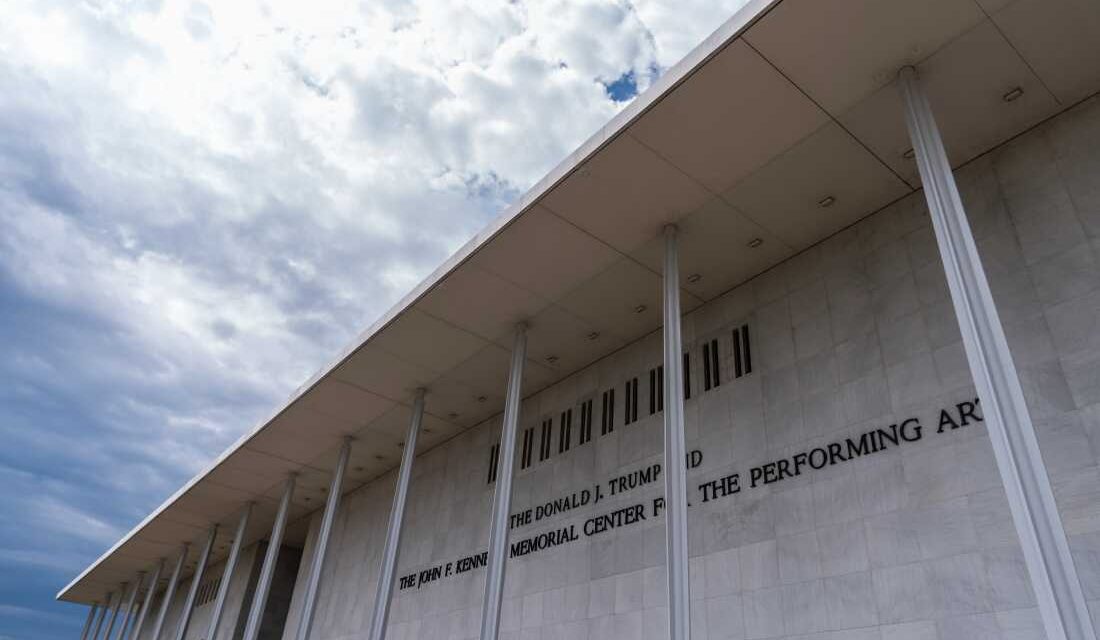
A federal judge has intervened to stop President Trump from having his name added to the Kennedy Center. The arts complex in Washington, D.C. is dedicated to the memory of the late President John F. Kennedy.
On Friday, U.S. District Court Judge Christopher Cooper ruled that the Kennedy Center must retain its name, as mandated by its founding law. He clarified that only Congress has the authority to alter the name designated for President Kennedy. This decision also temporarily stops the administration’s plans to close the Kennedy Center for a two-year renovation starting in July.
The Kennedy Center’s foundational law clearly states that the Center is named for President Kennedy, and cannot adopt any other formal name based on the board’s unilateral decision. The Center’s name was given by Congress, and only Congress is empowered to change it.
A spokesperson for the Kennedy Center informed NPR that they plan to challenge the court’s decision. Roma Daravi, Vice President of Public Relations for the complex, indicated in an email that although the decision is being reviewed, there remains an urgent need for significant restoration at the Center. President Trump and Congress have secured $257 million for this purpose, and the center is committed to restoring the Kennedy Center as a cultural landmark.
NPR reached out to the White House for comment but did not receive a response immediately.
As part of his orders, Judge Cooper mandated the removal of any signage and online materials that refer to the “Donald J. Trump and John F. Kennedy Memorial Center for the Performing Arts,” or any variant thereof, within 14 days. Furthermore, plans to close the Kennedy Center for renovations have been halted temporarily.
Trump and the center’s current board members, appointed by him, had slated the renovations to start in early July following the 250th anniversary celebrations. Judge Cooper criticized the renovation plans as vague in his detailed 94-page ruling, mentioning that board members lacked sufficient information to make an informed decision at their March 16 meeting.
The center has been scaling down its programming, having already dismissed much of its programming staff. Judge Cooper noted a Truth Social post by President Trump in February, which claimed a year-long review of the center had taken place, involving various experts and consultants. The ruling disputes this claim.
The lawsuit leading to this ruling was filed by Rep. Joyce Beatty of Ohio in March. Beatty, an ex-officio Kennedy Center board member, had her voting rights on the board rescinded last year. Although this ruling prevents an immediate closure of the center, Judge Cooper emphasized that if a closure occurs in the future, it must be founded on adequate, independent decision-making. This would need to consider the center’s dual role as a premiere arts venue and a memorial to a past President.
 Trump Highlights Ravens During Industrial Site Visit
  Collins vs. Jackson: Maine Senate Debate Highlights
  Sen. John Curtis Calls for Hearings Involving Donald Trump Jr. and Hunter Biden
  Understanding Immigration and Identity in California Politics
  Republican Steve Hilton’s Unconventional Campaign for California Governor
  Race for Kane County Board District 3: Candidates Address Key Issues