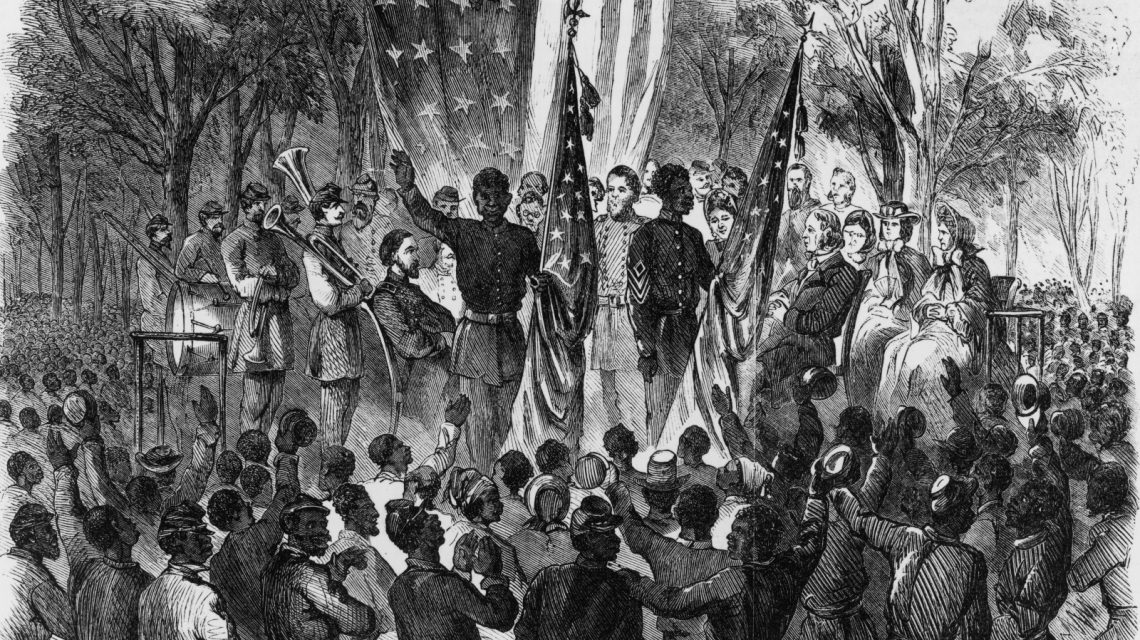
Juneteenth is widely recognized as a significant emancipation celebration in the United States, but it is not the only one. President Abraham Lincoln issued the Emancipation Proclamation on January 1, 1863. This document declared that all enslaved individuals in Confederate states “are, and henceforward shall be free.” However, the complete freedom of all enslaved people in the U.S. took years to accomplish. Juneteenth, along with other Emancipation Days, commemorates this journey.
Jim Downs, a professor specializing in Civil War Era Studies and History at Gettysburg College, highlighted that many perceive emancipation as a singular event associated with the Emancipation Proclamation. In reality, the end of slavery was a prolonged and uneven process. In various regions, enslaved people secured their freedom by fleeing to Union lines or exploiting wartime disruptions. In others, freedom arrived through military occupation, state legislation, or constitutional changes, culminating in the Thirteenth Amendment.
The existence of multiple Emancipation Days reflects that history,Downs noted.
Celebrated annually on June 19, Juneteenth marks the 1865 end of slavery in the U.S. It was when 250,000 African Americans were informed of their freedom after Union soldiers took control of Galveston, Texas. Juneteenth became an official holiday in Texas in 1980 and a federal holiday in 2021. Yet, numerous states have their own emancipation celebrations.
Florida
Florida observes Emancipation Day on May 20. This date marks when emancipation was declared in Tallahassee on May 20, 1865, 11 days post-Civil War. In Key West, some communities celebrated as early as 1863 due to the U.S. Army’s presence, according to the Emancipation in Florida website.
Tennessee
Tennessee’s Emancipation Day is on August 8. The Tennessee Historical Society records that Governor Andrew Johnson freed his slaves on August 8, 1863. Sam Johnson, a former slave of the governor, organized the first August 8 celebrations in 1871.
Mississippi
Emancipation Days in Mississippi are marked differently throughout the state. In Columbus, since 2005, the Mississippi School for Mathematics and Science students have commemorated the day with arts events on May 8. This date signifies the arrival of Union troops from Alabama in 1865, liberating the enslaved in Columbus.
Washington, D.C.
On April 16, 1862, over 3,000 individuals were freed from slavery in D.C. The city celebrates DC Emancipation Day every April 16, honoring the fight for freedom. Recognized as an official District holiday since 2005, it includes parades, reenactments, and cultural events.
Ohio
Ohio marks its Emancipation Day on September 22, the date when Lincoln issued a preliminary version of the Emancipation Proclamation. According to End Slavery Now, gatherings were held to hear the Proclamation read aloud. Ohio made September 22 an official Emancipation Day in 2006, celebrated with food, concerts, and reenactments.
Maryland
Maryland abolished slavery legally on November 1, 1864, a year after the Emancipation Proclamation. Recognized officially since 2025, Maryland Emancipation Day is celebrated with events, concerts, and speeches elucidating its significance.
Why Is Juneteenth So Recognized?
Downs explains that Juneteenth is highly recognized not because it was the first celebration but because Black Texans maintained and celebrated it through generations. As Texans moved across the country, these traditions spread, turning Juneteenth into a national symbol of freedom and its deferred fulfillment.
Though Americans may seek a single date for slavery’s end, freedom unfolded uniquely across different areas, resulting in various commemoration traditions. States like Washington, D.C., Maryland, Florida, and others developed distinct ways to honor the progress toward freedom.
These celebrations emerge from a long tradition of emancipation events,Downs stated.
Before the Civil War, African American communities like those in Philadelphia recognized emancipation in the British Caribbean. They used these occasions to celebrate freedom and protest ongoing slavery in the U.S.
Freedom arrived at different moments across communities,Downs said, acknowledging the difficulties in pinpointing a single day for such a complex history.
Rather than view multiple Emancipation Days as confusing, Downs suggests they remind us of the diverse struggles and experiences through which they were achieved.
 Artistic Chronicle of Communities’ Recovery Post-Hurricane Helene
  Chicago History Museum’s Latin American Exhibit Sparked by Student Protests
  DNA Links Jefferson to Hemings Descendants
  Ari Emanuel’s Memoir: A Business-Centric Narrative
  Celebrating Day of the Dead: Students Craft Calaveras in Pilsen
  Controversial Revelations from Charles Spencer’s New Book on Princess Diana