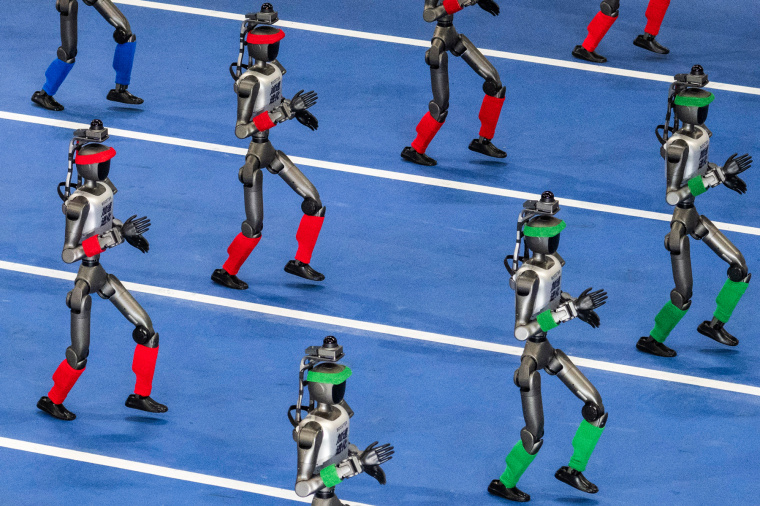
China’s humanoid robots demonstrated their capability to run faster than the quickest humans, but now face a new challenge: assessing their ability in packaging and warehouse tasks, requiring precision in jobs like cable connection. This evaluation takes place during the World Humanoid Robot Games, a five-day event starting Saturday in Beijing. Combining human sports with factory, restaurant, office, and emergency scenarios, the games aim to test these robots’ capabilities beyond flashy performances.
The games, widely promoted by Chinese state media, feature 51 events, including 30 sports competitions and 21 scenario-based contests. Huawei, a tech partner, notes that over 40% of these require autonomous robot operation.
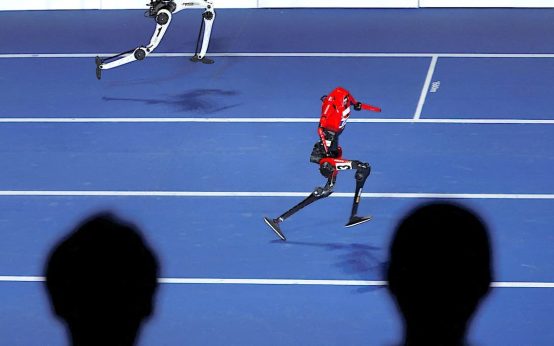
On Saturday, two robots eclipsed Usain Bolt’s 100-meter world record of 9.58 seconds in a rapid improvement from 2025 when robots completed the race in over 20 seconds. However, braking issues persisted, with robots crashing into thick mats positioned after the finish line.
Humanoid robot beats Usain Bolt’s 100-meter record.
Another robot ran 400 meters in 39.7 seconds, surpassing South African Wayde van Niekerk’s world record of 43.03 seconds. According to Xu Qiaosheng, a spectator and robotics investor, the increased intensity poses significant demands on battery management and thermal dissipation, marking essential progress for China’s industrial sector.
Robots will also compete in tug-of-war and weightlifting, while events like Tai Chi and pitch-pot—a traditional Chinese sport involving throwing sticks into a vase—add a futuristic twist.
The true test emerges when robots face real-world imperfections like misplaced cables, unreachable objects, or shifting packages, assessing their capability to identify, position, apply force, and recover from errors autonomously.
Yu Chao, CEO of Lumos Robotics, believes the games could enhance hardware and showcase the industry’s potential, with long-term value hinging on real-world problem-solving. Chao asserts that mere physical feats do not enhance efficiency; utility in practical scenarios is vital.
Apart from the familiar sports events, robots will compete in EV charging, restaurant work, emergency handling, and hand-dexterity challenges. Additional tests include industrial assembly and material loading, demanding vision, mechanical alignment, and force control.
Beijing-based startup Galbot plans to stage an autonomous humanoid tennis match, featuring singles and doubles play, with ball tracking, serving, and returning shots.
For Hua Rong, chief marketing officer at Zeroth Robotics, the ultimate test comes post-demonstration, determining whether products effectively solve user challenges.
 Governor Abbott Criticizes Data Center Developers Amid Growing Opposition in Texas
  Humanoid Robots Outshine Human Records at the World Humanoid Robot Games
  Data Center Disputes and Foreign Influence: Analyzing the Concerns
  Former SpaceX Engineers Revive Dormant Nuclear Experiment for Data Centers
  US Urged to Lead in AI to Secure Economic Future Against China
  Chinese Humanoid Robots Break Records at World Humanoid Robot Games