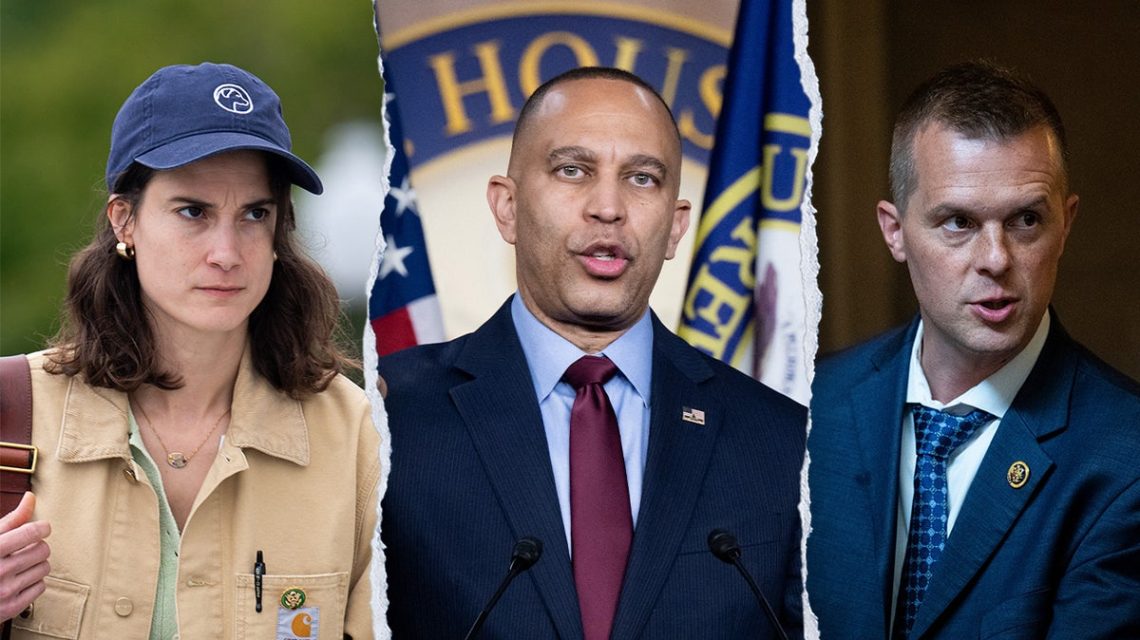
Democrats in Washington recently faced criticism after two representatives took a stand that opposed the party’s norms. Representatives Jared Golden of Maine and Marie Gluesenkamp Perez of Washington parted ways with their party on September 1. They supported a procedural rule that allowed the House to deliberate on Golden’s Northeast Lobsterman Protection Act and a resolution condemning socialism. The decision passed narrowly with a 210–208 vote, being pivotal due to opposition from five Republicans.
House Minority Leader Hakeem Jeffries and other key Democratic leaders were taken aback. They labeled the move as a “significant breach of trust” and suggested it warranted a “serious response.” The reaction involved calling upon the Committee on Caucus Rules to evaluate the situation. The core issue here relates to the political message sent by Democrats. Supporting Maine’s lobstermen against heavy regulations and permitting a vote to condemn socialism have been portrayed as acts of political defiance within the Democratic Party.
Most Americans want representatives who prioritize their livelihoods.
Golden co-sponsored a proposal to safeguard Maine’s lucrative lobster industry, a critical economic component that employs many and sustains coastal communities. Meanwhile, Gluesenkamp Perez represents a district in southwest Washington where families similarly rely on fishing and natural resources. Both representatives prioritized workers over regulations they believed were unworkable. Golden highlighted the dilemma faced by politicians, “Could you imagine going home to your constituents and being like, ‘I was trying to help you, but I had to vote no’?”
This development comes at a politically risky time since many Americans identify as working class. Pew Research Center data reveals that 60% of adults resonate with this classification, growing from 54% in 2024. This includes half of college graduates and upper-income earners, with 77% among blue-collar workers echoing the sentiment.
The Democrats’ reaction spotlighted a party that places an emphasis on party loyalty and ideology over the working class. This stance is perilous, especially as Democrats hold a tenuous advantage on cost-of-living issues, a major concern for midterm voters. A Reuters/Ipsos poll shows a 36% preference for Democrats over Republicans on this issue, with 37% being either indifferent or undecided, highlighting a reliance on dissatisfaction rather than confidence in Democrats’ economic framework.
Polling indicates a space for Republicans to redefine Democrats succinctly: “Democrats are against you.” This perception expands when Democrats defend their economic stance. The House passed a resolution against socialism, yet 192 Democrats opposed while only a handful supported it.
Democrats assert the resolution contained Republican election-security provisions. Four Democrats proposed a clean anti-socialism amendment, which never saw a vote. While this may clarify four Democrats’ positions, it neither elucidates the stance of the other 188 nor assures voters of their economic agenda’s distinctness from socialism.
The situation shines a light on Democrats potentially penalizing members who defend workers, raising doubts about the party’s affinity with working individuals, despite rhetoric suggesting otherwise. Republicans argue that prosperity relies on people’s freedom to work and pursue the American Dream independently, citing governmental control as a source of higher taxes, regulations, and costs. This, they argue, deprives families and businesses of economic freedom.
Moving forward, Republicans are poised to present these developments to American families in tangible terms, focusing on autonomy as a path to a thriving economy. Democratic priorities have come under scrutiny, suggesting party ideals overshadow working Americans’ needs. The ultimate commentary will occur at the elections, as voters wield their power.
Mehek Cooke, an attorney and political strategist, provided these insights.
 Missouri Voters File Lawsuit Over Redistricting Referendum
  The Rising Influence of Pardon Brokers in Washington
  Utah Women Challenge Political Traditions
  Key Senate Races Tighten Ahead of Midterm Elections
  Russian Oligarch’s Role in Donald Trump Jr.’s Wedding Raises Security Concerns
  Maine’s Unusual House Race: A Shift from Centrist to Conservative