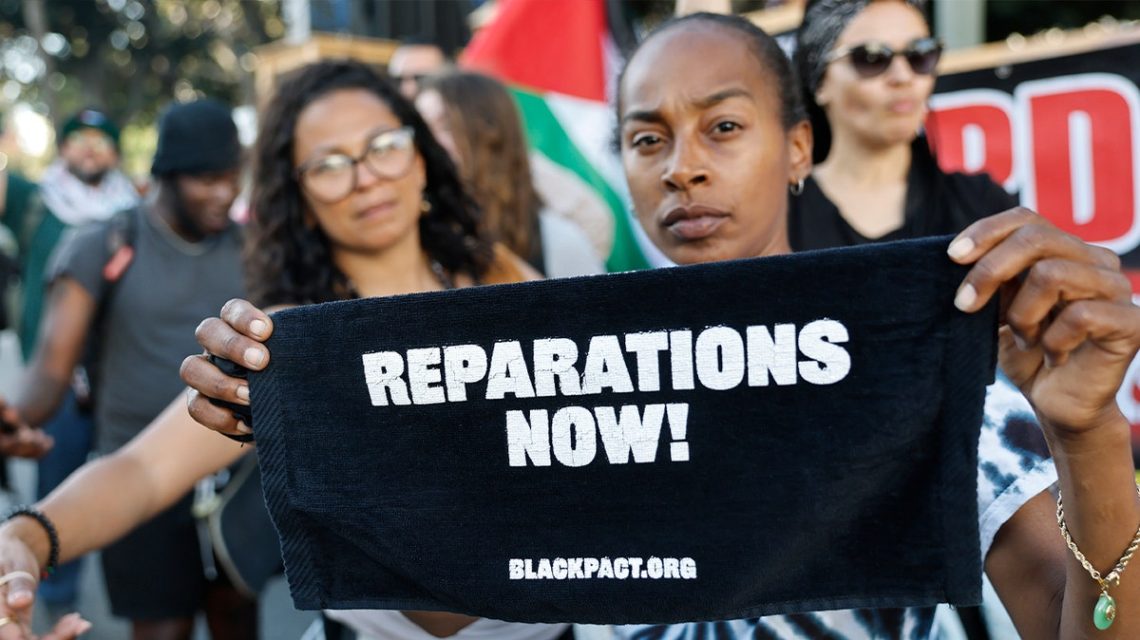
The Department of Justice’s Civil Rights Division has filed to join a class-action lawsuit against Evanston’s “Local Reparations Restorative Housing Program.” Federal prosecutors claim this program in the Chicago suburb illegally allocates public benefits based on race and ancestry.
Assistant Attorney General Harmeet K. Dhillon stated, “There are ways for a city to address past discrimination or aid its most vulnerable communities. Distributing money based on race is race discrimination and it is illegal.”
The reparations program by Evanston, Illinois, is the subject of a federal lawsuit.
The DOJ argues that the program violates the Equal Protection Clause of the Fourteenth Amendment and the Fair Housing Act due to its race-based financial assistance structure. Introduced in 2019 and launched in 2021, this initiative offers $25,000 grants to eligible Black residents or their descendants. These funds help with home purchases, mortgage assistance, property repairs, or can serve as direct cash payments.
Eligibility criteria require applicants to be Black, having lived in Evanston as adults between 1919 and 1969, or be direct descendants of city residents from that era. This program aims to address historical economic disparities.
Proponents view the initiative as essential for closing generational economic gaps. However, federal authorities contest its design, stating the program isn’t “narrowly tailored” because it uses race as the sole eligibility criterion without proving personal financial or physical harm from past city policies.
Assistant AG Harmeet Dhillon says simply handing out money based on race is illegal.
In May 2024, Judicial Watch, a conservative legal organization, filed a lawsuit representing six non-Black Evanston descendants, alleging unconstitutional exclusion. U.S. District Judge John F. Kness allowed the lawsuit to proceed in March, sidestepping the city’s dismissal request.
Since its inception, Evanston allocated over $7 million of the $20 million fund, sourced from recreational marijuana sales tax revenue. Earlier this year, the city’s Reparations Committee announced additional allocations to 44 more residents.
Following the DOJ’s intervention, the City of Evanston released a brief statement standing by the initiative but declining to expand on the specifics of the active trial.
The DOJ’s intervention request awaits court decision.
Other jurisdictions, such as Illinois, also consider reparations initiatives. Near Evanston, Chicago Mayor Brandon Johnson launched “Repair Chicago” to engage with Black residents on historical harms, seeking to develop reparations policies.
The DOJ did not provide further comment. Meanwhile, reporter Joshua Q. Nelson covers this evolving story, focusing on culture, education, and policy changes linked to reparations, Department of Education, and immigration matters. He joined Fox News Digital in 2019 after completing studies at Syracuse University and University of Pennsylvania.
For story tips, contact Joshua at [email protected] or follow him on social media platforms.
 Karoline Leavitt on Trump’s Direct Diplomacy
  Trump’s Speech Targets Iran’s Nuclear Ambitions at U.N.
  Impact of Tariffs on Everyday Products
  Senator Bernie Moreno Urges DOJ to Address Drug Policy Enabling Forced Abortions
  Karoline Leavitt Offers Insights on Trump’s Calls With Putin and Xi
  Curtis Pushes for Investigation into Trump Jr. and Biden