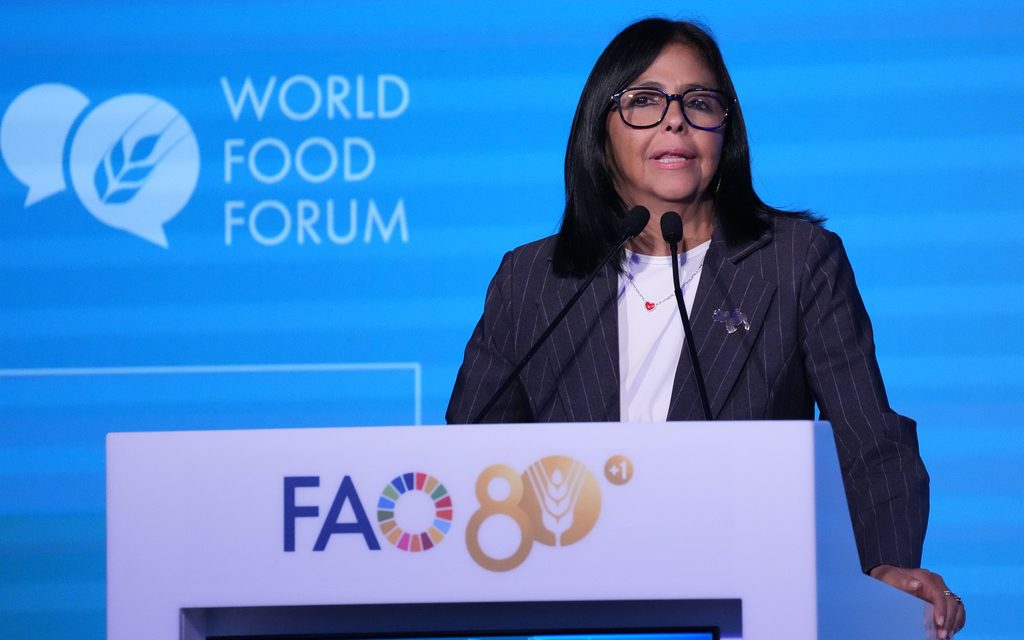
Delcy Rodríguez, the acting president of Venezuela, addressed attendees at the World Food Forum 2026 in Rome on October 12, 2026. However, back in Venezuela, the primary armed threats do not originate from within the country. Instead, Colombian groups like ELN and FARC militia dissidents dominate border regions in a violent struggle for control. To finance their operations, these groups exploit Venezuela’s minerals, selling these to Chinese buyers for considerable gain. Consequently, over 56,000 Venezuelans have fled this violence.
Last month, from Barranquilla, Colombia, Secretary of State Marco Rubio highlighted that these “terrorist organizations” operate unimpeded in the border areas. He accused them of committing crimes in Colombia only to retreat to Venezuela for refuge. Rubio emphasized the need for the Trump administration to pressure Venezuelan officials, who allegedly protect these groups, as a strategy to aid Colombia’s fight against terrorism.
Venezuelan cartels, like Tren de Aragua, also thrive in this environment. They profit significantly from gold and other critical minerals. Partnerships between officials, military leaders, and cartels result in corrupted issuing of trading permits and resources. These relationships allow groups to extract significant resources, including tin, rare earths, and coltan. While the U.S. could benefit from these resources to reduce dependence on Chinese minerals, China remains the primary buyer.
Venezuela’s mineral trade process involves using various means to smuggle goods into China, including boats and official vehicles crossing the Colombian border. Corrupt Venezuelan officials purportedly assist with falsified export papers, facilitating this illegal trade. Every shipment of minerals fuels China’s dominance in mineral processing, compromising U.S. economic stability.
The current U.S. strategy, including sanctions with loopholes allowing U.S. companies to acquire Venezuelan minerals, bolsters crime-indirectly supporting terrorists. These actions give the illusion of legitimate commerce, overshadowing the reality that nearly all Venezuelan minerals are illegally sourced.
Despite exceptions to certain U.S. banking regulations to encourage investment in Venezuela, American enterprises remain hesitant. Previous U.S. attempts to broker significant mineral deals have failed, primarily due to ties between prospective suppliers and criminal networks. Consequently, financial benefits accumulate in the hands of criminal elements, leaving American interests and taxpayers disadvantaged.
The Trump administration’s policy, which appears to support Delcy Rodríguez while minimizing the problem posed by illicit mineral exports to China, undermines potential U.S. corporate involvement. By permitting “ask-no-questions” dealings with Chinese buyers and neglecting the regional crisis fueled by criminal proceeds, the administration contributes to the entrenched cycle of bribery and terror financing.
The decision America faces is critical: continue endorsing the Rodriguez regime, thus enabling its complicity with terrorists and allowing strategic minerals to flow to China, or recognize Venezuela’s malpractices as the true adversary. As Secretary Rubio articulated, the prevailing condition is “not sustainable.” Action is imperative.
Josh Birenbaum serves as the deputy director of the Center on Economic and Financial Power at the Foundation for Defense of Democracies. Cristina Vollmer Burelli is the founder of SOSOrinoco, an advocacy group monitoring illegal mining in Venezuela.
 Pope Leo XIV’s Cancer Discovery and Recovery Detailed by Surgeon
  Trump Criticizes Zelensky Over Resumed Strikes on Russian Oil Facilities
  Katie Wiles’ Controversial Visit to Republika Srpska
  Democracy Under Threat: The Rise of Politically Charged Messaging
  Trump’s Strategy for Greenland: Military and Resource Expansion
  The Illusion of Ceasefire Between Russia and Ukraine