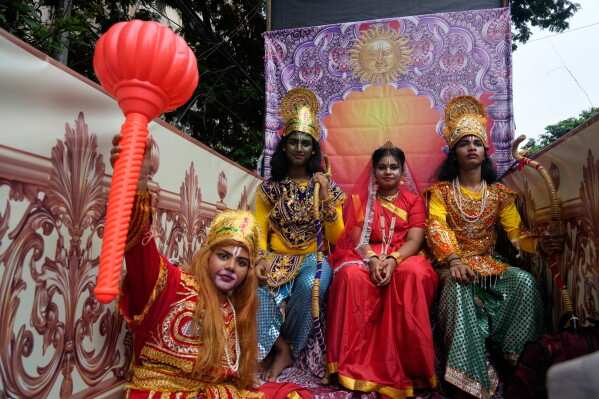
In Kyoto, Japan, the Gion Matsuri festival brings a spiritual connection for participants like Katsushi Horikawa as they ride on towering floats through the streets. Originating over a thousand years ago, this festival was initially a ritual to ward off epidemics and is celebrated each July in Kyoto.
Horikawa describes feeling the presence of deities more intensely when atop the floats. The parades, filled with music, dance, and song, attract large crowds and tourists annually. The largest floats weigh up to 12 tons, emphasizing the grandeur of the event. Despite the festive atmosphere, the festival has deep roots in religious tradition and divine protection.
These performances are offerings to the gods, not merely for entertainment,said Fabio Rambelli, a professor of religious studies at the University of California, Santa Barbara.
A Festival with Religious Depth
The Gion Matsuri started in the late 9th century to appease spirits believed to spread disease, taking its name from Kyoto’s Gion District and the word ‘matsuri,’ meaning festival. At the core of the celebration is Kyoto’s Yasaka Shrine, which has long been revered as a protector against calamities. The shrine’s history highlights the intertwined nature of Shinto and Buddhism in Japan.
Before becoming solely Shinto, Yasaka Shrine was a Buddhist temple until about 150 years ago, explained Rambelli. Historically, the shrine’s main deity was Gozu Tennō, an ox-headed figure associated with both spreading and averting epidemics.
In earlier times, Gion Matsuri processions involved carrying this deity through the city, mirroring current parade traditions. According to Rambelli, these processions demonstrated the deity’s power to confront evil.
Japan’s Religious Transformation
In 1868, during the Meiji era, Shinto and Buddhism were formally separated, bringing Shinto shrines under government control, and positioning the emperor at the center. Andrea De Antoni, professor of anthropology and religious studies at the University of Kyoto, explains that this purification process redefined Shinto while inciting an anti-Buddhist movement which led to the destruction of many Buddhist artifacts.
Although Shinto was separated from the state after World War II, its traditions continue to reflect complex historical and cultural influences. De Antoni notes that Shinto revolves around the worship of deities known as kami, embodying animism with similarities to practices found in Southeast Asia and the Pacific.
The Role of Festivals
Japanese festivals provide opportunities for deities to be brought into the streets, fulfilling sacred and community roles. Jacques Garrigues, a long-time Kyoto resident from France, notes the importance of shared religious experiences during the festival, despite differing religious significance compared to his home country.
A notable tradition during Gion Matsuri is the selection of a young boy as a sacred messenger. Throughout the parade, this boy sits on one of the floats, his feet never touching the ground. Participants spend months preparing for the celebrations, with neighborhoods carefully constructing floats to ward off evil spirits.
Atsushi Matono, responsible for placing the shingi, a sacred tree, at the top of one float, describes a profound sense of the divine. Sharing Horikawa’s sentiment, Matono carries out his duties with reverence, feeling the presence of the gods as he prepares each float.
 Fat Bear Week: A Unique Annual Tradition at Katmai National Park
  Lucas Museum of Narrative Art: A New Cultural Landmark
  Northlight Theatre’s ‘The Front Page’: A Satirical Nod to Chicago’s Journalistic Past
  Monday Screencaps: Musings and Sports Insights
  Examining the Impact of the War on Poverty Initiatives
  The Value of Unsupervised Play in Child Development