Ridhvi Saxena, an 18-year-old aspiring cardiologist, confidently completed her medical entrance exam in India on May 3. Her plans took a hit when the testing agency nullified the exam results due to a leak and mandated a retake for all candidates. Authorities have since enacted a temporary nationwide ban on the Telegram messaging app, citing its role in facilitating exam leaks.
This disruption has left Saxena feeling disheartened. ‘I feel very cheated on and betrayed by the system,’ she shared in a phone call with NBC News. Saxena had been eagerly anticipating college life, but the necessity of retaking the exam has left her feeling exhausted and uncertain. The retest, scheduled for Sunday, adds further strain.
Over 2 million students in India participated in this year’s NEET undergraduate exam. This intense exam serves as the entry point to India’s medical schools, evaluating knowledge in physics, chemistry, and biology through multiple-choice questions. Students often invest years of focused study to prepare. For many like Saxena, who had previously attempted the NEET, the announcement to discard their results feels devastating.
Saxena expressed frustration: ‘You’ve sacrificed quality time with your family, and you’re just around four walls for these two to three years with your books. And then, when you finally get a taste of freedom, the Indian education system just lets you down.’
In response to the leaks, India’s Central Bureau of Investigation launched a probe, and the Ministry of Electronics and Information Technology enforced the Telegram ban until June 22 under a law that permits blocking online sites for national security reasons.
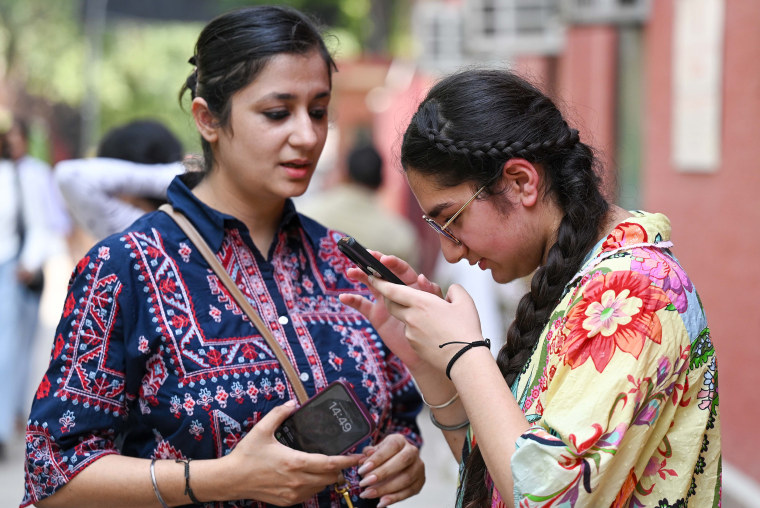
Students check exam results on cellphones in New Delhi on May 13.
Sanjeev Verma / Hindustan Times via Getty Images
The National Testing Agency, which manages the NEET, believes the ban is crucial for conducting examinations securely. However, Pavel Durov, Telegram’s founder, criticized the action as unjustly penalizing over 150 million users instead of targeting those responsible for the leaks. Durov pointed out that leaks merely migrated to different platforms.
In Delhi, the High Court dismissed Telegram’s request to lift the ban, confirming the government’s adherence to legal processes. This decision has raised concerns among digital rights activists about increasing controls over online expression in India, such as social media take-downs and account restrictions.
The Internet Freedom Foundation, an Indian nonprofit, stated on X that the Telegram ban sets a troubling example affecting the open internet far beyond this specific incident.
This year has posed various challenges for India’s education sector. The Central Board of Secondary Education (CBSE) faced public criticism due to electronic marking glitches that resulted in incorrect grading and missing answer sheets. Aspiring cybersecurity researchers have exposed vulnerabilities within CBSE’s systems.
The situation has sparked protests across the nation, including demonstrations demanding the resignation of Education Minister Dharmendra Pradhan, led by the Cockroach Janta Party movement.
A protest against the alleged NEET paper leak in New Delhi on May 14.
Arun Kumar / India Today Group via Getty Images
Students doubt the effectiveness of the Telegram ban in preventing exam issues. Alternatives such as virtual private networks provide continued access, and the ban doesn’t resolve the underlying issue of exam security. The NEET exam in 2024 also saw leaks, but no retest ensued.
Proton VPN observed a 120% surge in registrations from India following the ban, according to the company’s general manager, David Peterson.
Anoop Girijesh, another NEET candidate, described the situation as a short-term fix that avoids addressing the root cause. ‘It doesn’t give us confidence; it just makes us feel like they’re trying to stop the noise rather than fixing the leaks,’ he commented.
The National Testing Agency assured students on X that comprehensive safeguards are now in place for the upcoming exam, emphasizing that the choice to retest was made for their benefit. Yet, Girijesh remains skeptical, citing ongoing security concerns.
Requests for additional comments from both the National Testing Agency and Telegram went unanswered.
 Expansion of Data Centers Fueled by AI Development
  Impact of Removing Tax-Exempt Status from Private Schools
  Beijing’s Tactical Undermining of U.S. Supremacy Through AI
  AFL Investigates Fairfax County Schools’ 9/11 Teaching Guidance
  Controversy Surrounds Automated License Plate Readers Across the U.S.
  Trump and Harp Sued Over Truth Social Subscriber Program