At least 13 fatalities have been reported in southwestern Japan following a magnitude-7.1 earthquake, according to Prime Minister Sanae Takaichi. Rescue operations are underway to locate survivors trapped in the debris at a shopping mall and paper mill.
Takaichi emphasized the urgency of the situation, stating, Even now, there are people waiting to be rescued, and this is a race against time. We will marshal all available resources on the ground to save and rescue as many people as possible.
This statement was made during a press conference in Tokyo.
The earthquake struck on Tuesday afternoon, impacting Kumamoto prefecture on Kyushu, Japan’s southern main island. The quake originated at a shallow depth of 6 miles, leading to tsunami warnings and the evacuation of coastal areas. The epicenter was located approximately 12 miles south of Kumamoto city, home to about 700,000 residents.
Though the tsunami warning was soon lifted, significant damage was sustained throughout the region. Historical sites, such as Kumamoto Castle, suffered extensive damage. Repair work on the castle was already underway due to damage from a previous earthquake in 2016. Infrastructure damage included ruptured roads and widespread power outages. Local officials have warned residents to remain vigilant for heat stroke due to soaring temperatures reaching the 90s.
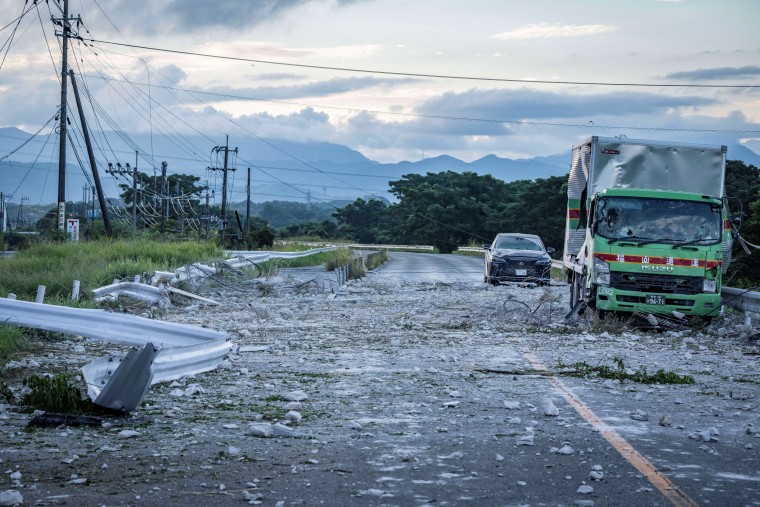
A truck and car were found damaged on a road covered with debris following an explosion at the Aeon Mall in Kashima, Japan. Two women in their 20s lost their lives in the mall’s partial collapse. Eight individuals have been rescued from this location, but four remain missing. Mall officials suspect a gas leak led to the explosion.
Seven people are reportedly missing following the collapse of a chimney at a Nippon Paper Industries facility in Yatsushiro. Thousands of military personnel have joined rescue efforts, while hospitals have treated numerous injuries. Some of those injured were passengers on Japan’s high-speed trains, which saw service suspension on Kyushu immediately after the quake.
NHK broadcast footage of a derailed freight train at Yatsushiro station, with carriages overturned and pillars of the Yatsushiro Shrine collapsed. Bullet trains and various airport operations were halted, and Kyushu Electric Power reported around 35,000 households remain without electricity.
Japan’s meteorological agency cautioned about possible earthquakes of similar magnitude. They indicated people should be alert for seismic activity peaking at intensity 7, particularly in the next two to three days.
No damage was reported at nuclear reactors in the area. Japan’s nuclear authority notified the International Atomic Energy Agency that the Sendai nuclear power plant remained unaffected by the quake. The U.N. watchdog stated in a post that monitoring would continue.
Japan’s nuclear facilities are scrutinized intensely during seismic events due to the 2011 incident when a 9.1-magnitude earthquake and tsunami caused meltdowns at Fukushima Daiichi nuclear power plant.
Japan frequently experiences earthquakes, as it sits on the “Ring of Fire,” a region where multiple tectonic plates interact, causing numerous earthquakes and volcanic eruptions. Around 20% of seismic events worldwide measuring 6.0 or greater occur in Japan.
 Trump Administration’s Plan to Resettle Afrikaners as Refugees
  Trump’s Vision on Iran, AI, and Global Security at the UN
  Lithuanian Leader Seeks U.S. Military Commitment Amid Rising Russian Threats
  Italian PM Giorgia Meloni Skips UN General Assembly Amid Growing Tensions
  Calls Grow for Ireland’s Soccer Team to Boycott Matches Against Israel
  New U.S. Military Bases Planned in Greenland Amid Strategic Security Deal