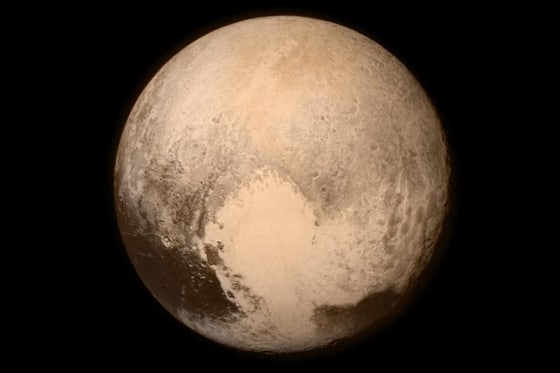
It’s been two decades since Pluto was reclassified from a planet to a dwarf planet, igniting a passionate debate that continues to resonate. The change came in 2006, following a decision by the International Astronomical Union (IAU), which led to widespread discussion among scientists and the public.
Nasa Administrator Jared Isaacman recently expressed his desire to “make Pluto a planet again,” highlighting the ongoing controversy surrounding Pluto’s status in our solar system. Despite its reclassification, the topic remains a point of contention, with many advocating for a return to Pluto’s previous planetary status.
NASA/Johns Hopkins University Applied Physics Laboratory/Southwest Research Institute Image
On August 23, 2026, Monday marks the 20th anniversary since Pluto was officially categorized as a dwarf planet. The decision has had lasting implications, not least for those who still feel the sting of what they consider a cosmic demotion.
The debate over Pluto’s classification underscores the broader challenges in defining what constitutes a planet. It raises questions about the criteria used in astronomical categorization and reflects differing perspectives within the scientific community.
While Pluto’s reclassification might seem like a minor detail to some, it highlights deeper issues regarding how astronomical objects are perceived and understood. As the debate continues, the conversation around Pluto serves as a reminder of the dynamic nature of scientific discourse and classification.
 Setback in the Search for Amelia Earhart’s Missing Plane
 Researchers Redefine Early Human Migration Timeline in North America
 Japan’s Mission to Explore Mars’ Moons
 Cancer Cells’ Response to Confinement
 Nor’easter Threatens East Coast with Strong Winds and Coastal Hazards
 Gulf of Mexico’s Twilight Zone Ecosystem Severely Impacted by 2010 Deepwater Horizon Oil Spill