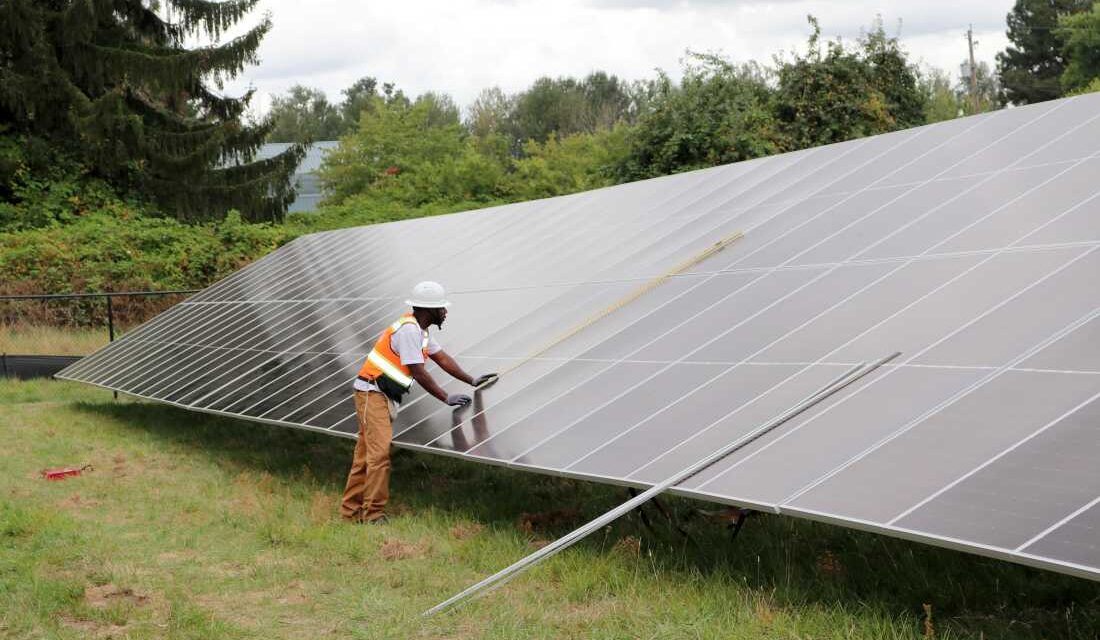
The PDX Community Solar project, backed by a grant exceeding $4 million from the Portland Clean Energy Fund, supports low-income residents in Portland’s Cully neighborhood. This initiative, part of broader climate solutions, highlights efforts by states, cities, and neighborhoods to combat climate issues amid federal government setbacks.
Local Climate Initiatives
Over the past seven years, Portland, Oregon, has made strides in reducing emissions and lowering energy costs. The city provided over 20,000 free air conditioning units to prepare households for heat waves and funded energy-efficient upgrades for 3,100 homes. Additionally, 2,000 individuals received training in renewable energy and construction sectors. These advances are due to a pioneering billion-dollar climate fund.
The Portland Clean Energy Fund
This fund represents a novel approach to racial, social, and climate justice, aiming to help vulnerable residents adapt to climate change. Voted in by a 65% majority in 2018, it was implemented in 2019 by imposing a 1% retail sales tax on large corporations within city limits. Unlike a sales tax, businesses contribute a small portion per sale; for instance, a $100 purchase earns the city $1. This initiative has successfully amassed around $1 billion, with projections reaching $1.6 billion by mid-2029.
It’s designed to enhance local climate solutions addressing real climate challenges and economic resilience,” said Sam Baraso, the program manager.
Challenges and Adaptations
Facing federal climate funding cuts, Portland’s fund continues to thrive. During President Trump’s second term, an executive order halted spending for a significant climate initiative spearheaded by President Joe Biden. In response, Portland’s community leaders initiated funding strategies almost a decade ago.
Nonprofit leaders focused on taxing large corporations to create funds prioritizing those impacted most by climate change. This approach ensures that communities affected by climate issues lead solution development.
Current Achievements
- Distributed over 20,000 free air conditioning units since 2022
- Constructed a solar project, benefiting 150 low-income families
- Planted 15,000 trees over five years in urban areas
- Converted six parking lots into community spaces
Since 2021, the fund has issued around $262 million in community-based grants, assisting in reducing greenhouse gases. Completed projects have cut 25,500 metric tons of emissions, akin to removing about 6,000 gas-powered vehicles annually.
Financial Management Issues
The fund’s growth incites debate among officials and groups about its allocations. A $75 million renovation proposal for the Moda Center with green technology and hiring 400 police officers sparked varied opinions. Maintaining the fund’s original climate-focused intent remains crucial.
Inspiration for Other Cities
Inspired by Portland, cities like Ann Arbor, Denver, and Seattle developed similar climate funds. Elizabeth Babcock from Denver’s Office of Climate Action highlights Portland’s model’s impact, though local conditions led these cities to tweak the tax approach to fit their needs.
Ann Arbor resorted to property tax increases, while Denver implemented a 0.25% sales tax, excluding critical items. This generated $41 million in its initial year. Professor Amruta Nori-Sarma emphasizes the importance of community input for effective fund development.
By mid-2029, the Portland Clean Energy Fund aims to complete its five-year strategy, reinvesting $1.6 billion into city initiatives.
 Cold Weather Alerts and El Niño Influence
  Turning Home Food Waste into Compost: A Guide
  Chicagohenge: When Sunlight Aligns with City Streets
  Fat Bear Week 2026: A Look at the Contest and Its Competitors
  California Governor Declares Statewide Emergency Ahead of El Niño Storms
  EPA Rollbacks and the Impact on Indiana Communities