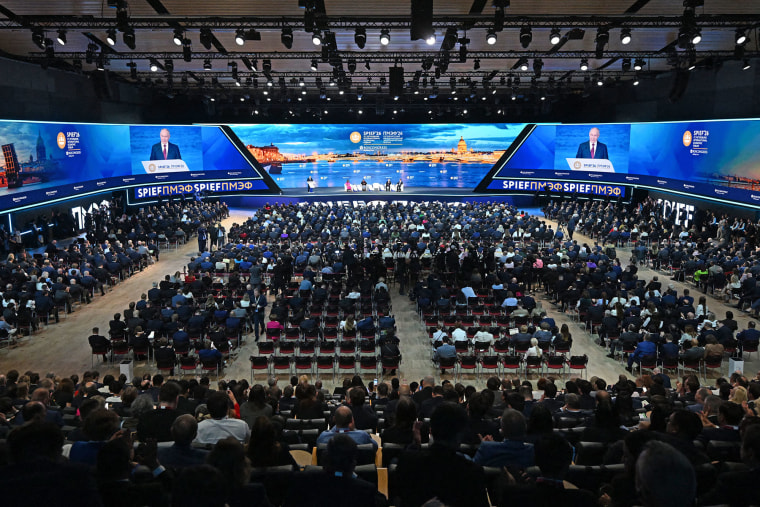
The International Economic Forum in St. Petersburg set the stage for Russian President Vladimir Putin’s latest address, surrounded by the familiar presence of government officials, business leaders, and supporters. However, this year, the event reflected a world mired in conflict and uncertainty.
The optimistic tone that followed a summit with U.S. President Donald Trump in Alaska has diminished. The war in Ukraine has reached a standstill, not only on the battlefield but also in negotiations. Recently, the U.S. House of Representatives passed bipartisan legislation proposing new aid for Ukraine and sanctions against Russia.
Complicating matters further, inflation has surged due to conflicts involving the U.S., Israel, and Iran. Ukraine’s persistent drone attacks exacerbate fuel shortages in Russia, which is already burdened with existing sanctions.
Despite the usual economic optimism, the current forum is dominated by discussions about drones. Russian-made drones displayed prominently at the event mirror the ones used in Ukrainian attacks that unsettle residents of the historic city.
President Putin dismissed Ukraine President Volodymyr Zelenskyy’s request for a direct meeting. He indicated that it would be more productive for experts to work through the issues first. Putin also questioned Zelenskyy’s authority to negotiate, especially with Ukraine’s presidential elections postponed.
Putin acknowledged former President Trump’s past attempts to mediate the conflict. However, he stressed that additional efforts are still necessary. Russia’s Deputy Prime Minister, Alexander Novak, emphasized Russia’s openness to improving ties with the U.S., clearly stating that the initiative now rests with Washington.
Significant security measures were in place for Putin’s address, including mandatory PCR tests for attendees. The leader was well-guarded while moving around the venue.
Iran’s influence has become a significant concern for Russia, noted by Russian Foreign Ministry spokeswoman Maria Zakharova. She believes it has now diverted U.S. focus away from Ukraine, which impacts the mediation efforts in the ongoing war.
Zakharova expressed concerns about reduced U.S. involvement, emphasizing the importance of continuous mediation efforts. “Unfortunately, they’re paying less attention, and we need them to pay more attention,” she emphasized.
The animosity between Moscow and Kyiv persists after four years of conflict. In a recent press briefing, Zakharova presented photos of teenagers Russia claims were casualties of a previous attack on a college dormitory in Luhansk, which Ukraine insists was a military target.
Efforts for a peaceful resolution seem distant. Zelenskyy again called on President Putin to end the war, warning of increasing domestic unrest otherwise.
Kirill Dmitriev, a Putin envoy, disclosed ongoing negotiations with U.S. envoy Steve Witkoff and Jared Kushner aimed at resolving the conflict. Despite claims of a near-ready agreement, Ukrainian advisor Dmytro Lytvyn reiterated Zelenskyy’s refusal to cede any Ukraine territory.
For the Russian economy, the toll from sanctions is tangible. Billionaire Vladimir Yevtushenkov admitted the sanctions’ impact on Russia, drawing parallels to Iran’s economic isolation. Although higher oil prices offer some relief, they do not fully counterbalance the effects of Russia’s own unresolved war.
While many Russian businesses face hardships, Yevtushenkov noted some adaptation after years of restrictions. He remains optimistic about eventual economic recovery once the conflict ends.
This year’s forum lacked the presence of European and American representatives. Instead, it saw participation from Saudi Arabia, Iran, and China.
Beyond geopolitical tensions, cultural discussions arose. With participation from figures such as Steven Seagal and Rodney Mims Cook Jr., the forum featured talks on potential cultural exchanges. However, as Cook remarked, establishing peace needs precedence.
The forum also touched upon the possibility of leveraging Russia’s natural resources as a means to rejuvenate U.S.-Russia relations. Throughout the event, Putin maintained a positive outlook, noting the country’s low unemployment rate and strides in AI development, despite rising challenges.
 Trump Administration’s Plan to Resettle Afrikaners as Refugees
 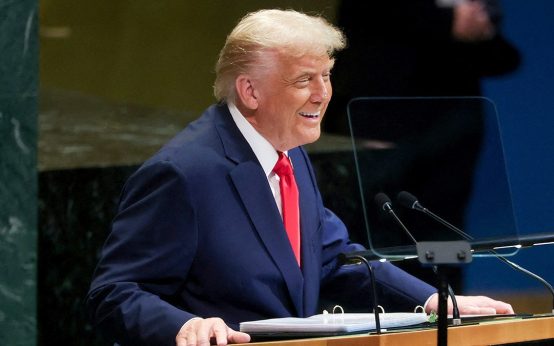 Trump’s Vision on Iran, AI, and Global Security at the UN
 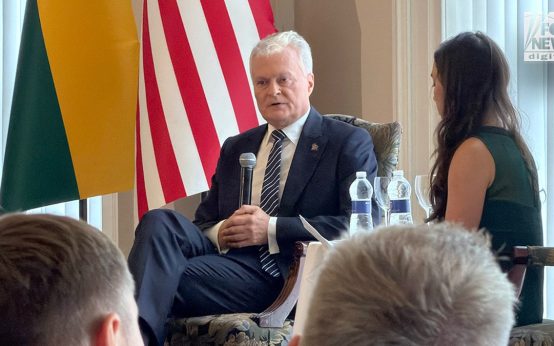 Lithuanian Leader Seeks U.S. Military Commitment Amid Rising Russian Threats
  Italian PM Giorgia Meloni Skips UN General Assembly Amid Growing Tensions
  Calls Grow for Ireland’s Soccer Team to Boycott Matches Against Israel
  New U.S. Military Bases Planned in Greenland Amid Strategic Security Deal