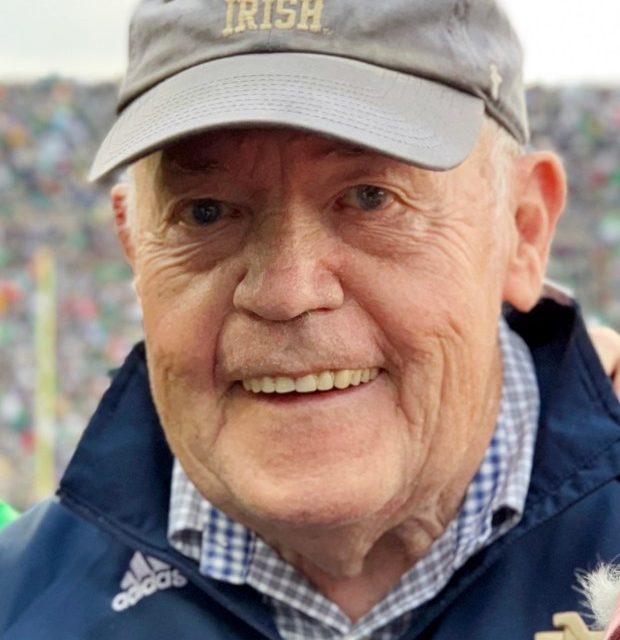
David E. Collins, former chairman of Johnson & Johnson’s McNeil Consumer Products unit, played a crucial role during the Chicago-area poisoning deaths in 1982 caused by Tylenol tampering. Collins emerged as the company’s public face, addressing potential bans on the product and leading recovery efforts. His leadership helped regain Tylenol’s market share, establishing a case study in corporate crisis management.
Collins passed away from leukemia complications on September 22 at 92, in Palm Desert, California, his son Pat confirmed. Originally from Oak Park, Collins attended Fenwick High School. He obtained a bachelor’s degree from the University of Notre Dame in 1956, followed by a law degree from Harvard in 1959.
Collins started his career at the New York City law firm Shearman & Sterling, later joining Johnson & Johnson’s legal team in 1962. Over 16 years, he became corporate secretary, general counsel, and joined the board of directors.
From Law to Leadership
In 1978, Collins moved into general management as president of McNeil Consumer Products. He managed various Latin American subsidiaries, eventually overseeing all of Johnson & Johnson’s consumer products.
He was a natural leader,said Roger Fine, a former Johnson & Johnson executive.He was smart, friendly, and gregarious but led more as a guide than a manager.
One notable achievement was securing a DEA license for Johnson & Johnson to manufacture codeine despite industry skepticism, demonstrating Collins’ innovative thinking.
Handling the Tylenol Crisis
In 1982, Tylenol capsules were poisoned with cyanide, causing seven deaths. Collins addressed the public with empathy, communicated safety commitments, and relocated to Chicago to manage the crisis firsthand. Collaborating with law enforcement, he provided lists of dissatisfied customers and employees to aid the investigation.
Collins reassured employees and shareholders about the company’s response on NBC’s Today show, emphasizing consumers’ confidence in the product. He led efforts to introduce tamper-resistant packaging, refusing to rebrand Tylenol.
By December 1982, Collins appeared in TV commercials requesting consumer trust in the new safety measures. By April 1983, sales neared pre-crisis figures, and by fall, Tylenol’s market share exceeded 30%, over three times higher than its lowest point post-poisoning.
Corporate and Educational Roles Post-J&J
In 1986, Collins became vice chairman of public affairs at Johnson & Johnson, retiring in 1988. Schering-Plough Healthcare tapped him to lead a consumer products division until 1994. Collins later taught at the University of California, Davis, Notre Dame’s Mendoza College of Business, and Dartmouth’s Tuck School.
He was involved with the Aspen Institute, served on Align Technology’s board, and contributed to Notre Dame Law School’s Advisory Council. We had so much fun,
said Thomas Prescott, former Align CEO, highlighting Collins’ value during Align’s early growth.
Collins is survived by his wife, Judy, sons Pat and Paul, daughter Ann Cazalot, six grandchildren, and siblings Chas, Eddie, and Penny. Services will remain private.