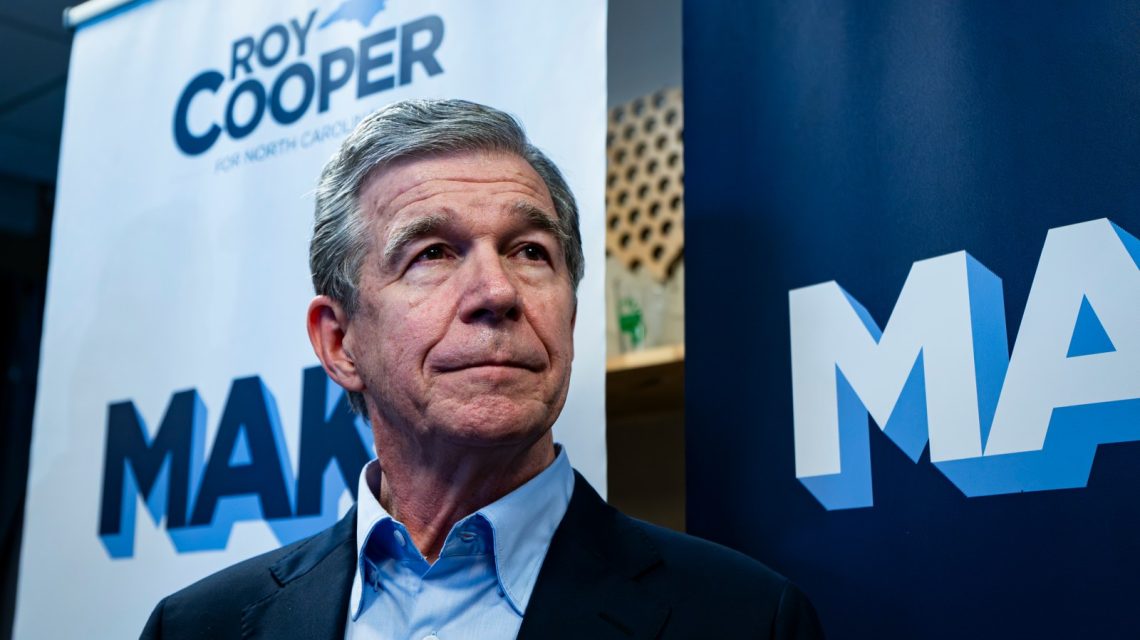
Former Governor Roy Cooper, a Democrat, is leading ex-Republican National Committee Chair Michael Whatley in North Carolina’s U.S. Senate race. This is based on the latest poll released on Tuesday. Democrats see the North Carolina seat occupied by retiring Republican Senator Thom Tillis as a top chance to flip a Senate seat in the 2026 midterm elections. They aim to gain majority control in November.
North Carolina is a pivotal battleground state. Although it narrowly supported President Donald Trump in 2024, it remains nearly evenly split between Democrats and Republicans. Since 2008, Democrats have not secured a Senate seat in North Carolina. However, they are optimistic due to the favorable national environment and Cooper’s popularity. Newsweek requested comments from the Cooper and Whatley campaigns via email.
Catawba College Poll Findings
A poll from Catawba College shows Cooper leading Whatley by 14 points. Forty-eight percent of respondents support Cooper, while 34 percent back Whatley. Fifteen percent are undecided. This is consistent with the pollster’s survey from March. Michael Bitzer, director of Catawba College’s Center for North Carolina Politics & Public Service, states Cooper’s lead is driven by independents, showing over two-to-one support for him over Whatley.
“This year appears set as a classic mid-term scenario: a referendum on the president and his party. Cooper commands significant support among those disapproving of the president, a majority of likely voters,” Bitzer wrote.
The poll surveyed 1,000 North Carolina voters between June 1 and June 10, with a margin of error of 3.83 percentage points.
Other Poll Results
Cooper enjoys high name recognition in North Carolina, establishing an early polling lead. A Harper Polling/Carolina Journal survey showed Cooper ahead of Whatley by over 11 points, with 49.8 percent expressing support for him. Meanwhile, Whatley received 38.7 percent. This poll included 600 likely voters on May 10 and May 11, with a margin of error of 4 percentage points.
A High Point University/YouGov poll from last month indicated Cooper leading by 8 points among likely voters. Fifty percent plan to support him, while 42 percent favor Whatley. This survey covered 703 respondents from March 26 to April 6, with a margin of error of 4.3 percentage points. Quantus Insights presented a more competitive race, with 49 percent supporting Cooper and 44 percent backing Whatley. This poll assessed 987 likely voters on March 31 and April 1, with a margin of error of 3.5 percentage points.
Prediction Market Trends
Prediction markets favor Cooper, showing an 85 percent chance of victory on Kalshi and 86 percent on Polymarket as of Tuesday. These markets allow traders to engage in contracts linked to political outcomes and events, aggregating real-money wagers into probability estimates. Prices fluctuate as traders react to polling, funding, candidate activities, and broader political trends. Though not always accurate predictors, these markets reflect trader sentiment at a specific moment.
Democrats’ Challenge in a Swing State
Democrats have seen better results in state gubernatorial elections but have struggled federally. The late Senator Kay Hagan was the last Democrat to win a Senate race in 2008, concurrent with Barack Obama’s state victory. In 2022, Democrat Cheri Beasley narrowly lost to Republican Ted Budd. Tillis defeated Democrat Cal Cunningham in 2020 by less than 2 points. In 2016, GOP Senator Richard Burr won against Democrat Deborah Ross by nearly 6 points. Despite setbacks, Democrats maintain control of the governor’s office.
Democrat Josh Stein succeeded Cooper and won November’s race decisively. His near 15-point victory followed Republican Mark Robinson’s campaign scandals. In recent years, Democrats have gained strength around Charlotte and Raleigh suburbs but struggled in rural regions. Trump won North Carolina in his three bids, albeit narrowly—by 3.6 points in 2016, 1.3 in 2020, and 3.2 in 2024.
Critical Stakes for Democrats in North Carolina
North Carolina remains essential for Democrats aiming to reclaim the Senate. Republicans currently maintain a 53-47 majority, pushing Democrats to flip 4 seats for control. Apart from North Carolina, they seek to capture a key seat in Republican-held Maine, another state leaning Democratic. Additionally, Democrats defend seats in Trump-won Georgia and Michigan. Winning these won’t suffice for majority control, leading Democrats to target more conservative states like Alaska, Iowa, Ohio, and Texas, despite unfavorable odds.
Future Outlook
Polls will serve as vital indicators of voter sentiment in North Carolina as elections approach. Forecasters such as Cook Political Report and Sabato’s Crystal Ball predict a lean toward Democrats, favoring them while maintaining a competitive outlook.
 Private Meeting Signals Potential Cross-Party Collaboration in U.S. Politics
  Democratic Candidate Crowley Emphasizes Shared Goals in Wisconsin
  U.S. Strategy Towards Iran Shifts to Economic Containment
  Runaway Bison Causes Stir in Loudoun County
  Armenia’s Shift from CSTO and Its Geopolitical Implications
  The Impact of Super El Niño on America’s National Parks