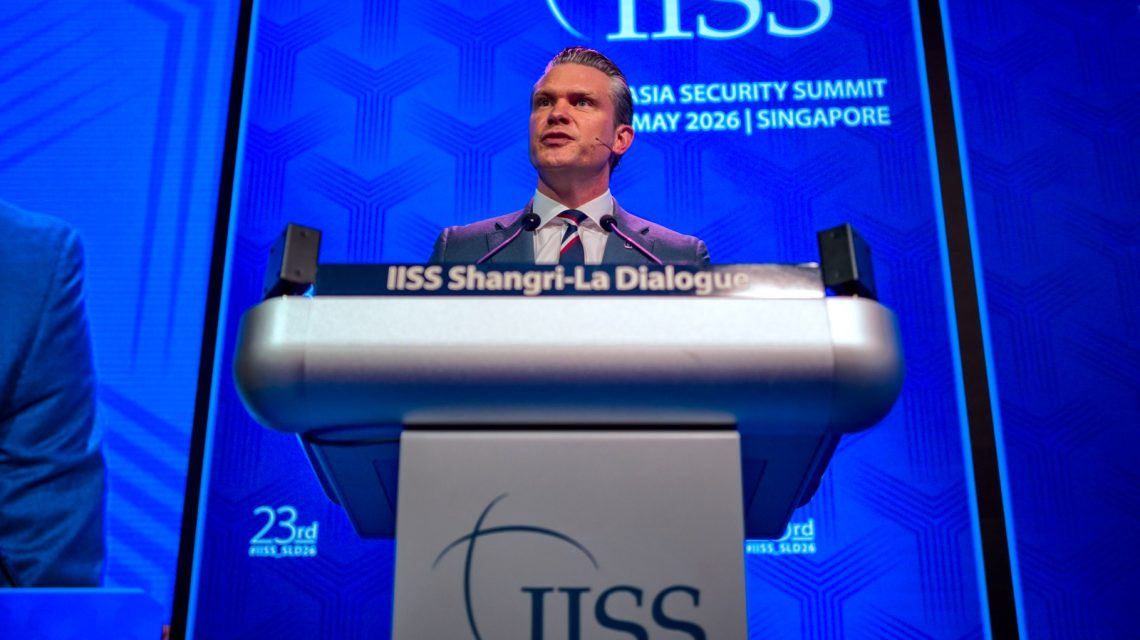
U.S. Secretary of Defense Pete Hegseth recently delivered a speech at the Shangri-La Dialogue, an important national security conference in East Asia held on May 30. While his speech contained references to the defense of the ‘First Island Chain,’ it notably omitted direct mention of Taiwan. Taiwan occupies a central position in this strategic line and remains a focal point in the Indo-Pacific region.
During his interaction with reporters, Hegseth expressed respect for China’s ambitions. However, these ambitions often include plans for territorial expansion and restrictions on international waters and airspace. This approach followed President Donald Trump’s recent comments about Taiwan, made after his meeting with China’s President Xi Jinping in Beijing. Trump described Taiwan as a ‘very good negotiating chip,’ which weakened America’s credibility in the region.
In response to perceived American vulnerability, China conducted two ‘joint combat readiness patrols’ in proximity to Taiwan and engaged in aggressive activities near Scarborough Shoal. Although China’s sovereignty claims over the South China Sea feature are unfounded, it has used forcible measures to assert control over the region from the Philippines.
American leaders have struggled to articulate a coherent stance on China, and regional concerns about Chinese aggression continue to grow. Following Hegseth’s address, Japanese Defense Minister Shinjiro Koizumi publicly questioned Hegseth, asking whether U.S. commitments to the region were ‘unwavering.’ This query symbolizes a shift in Japan’s approach, showcasing newer assertiveness and confidence among Japan’s leaders.
Lance Gatling from Nexial Research commented on Koizumi’s question, noting that it reflects the skillful public relations approach of Japan’s national security leaders. Gatling interprets this move as indicating Japan’s readiness to partner with others for regional security collaboration. He suggests that Japan is positioning itself as a dependable ally capable of seeking answers from America.
Japan exemplifies the strengthening collaboration between America and its partners in the region. Key initiatives include the cooperation between Japan, the U.S., and Australia on weapons production and the AUKUS submarine partnership. Additionally, the Quad, comprising Australia, Japan, the U.S., and India, and new informal groupings like JAROKUS (Japan, South Korea, and the U.S.) and JAROPUS (Japan, the Philippines, and the U.S.) are emerging.
The U.S. is also expanding its partnerships, notably with Indonesia. The signing of the Major Defense Cooperation Partnership agreement with Indonesia on April 13 emphasizes mutual defense cooperation. Indonesia’s strategic position, near the Strait of Malacca, critical for global maritime traffic, makes it a key regional partner. Over 102,500 vessels passed through this waterway last year, underscoring its importance.
James Fanell, from the Geneva Centre for Security Policy, emphasized the value of the U.S.-Indonesia partnership for securing maritime traffic against China’s regional aspirations. Fanell, a former director of intelligence operations for the U.S. Pacific Fleet, noted Indonesia’s preference for the U.S. as a partner, considering China’s territorial ambitions.
While Taiwan remains outside formal regional alliances, there is growing recognition of its security relevance. Last November, Japanese Prime Minister Sanae Takaichi addressed concerns about China’s potential actions against Taiwan, signaling Japan’s readiness to mobilize its Self-Defense Forces if needed. Despite threats from China following her statement, Takaichi stood firm and led her coalition to a historic electoral win, demonstrating that nations can resist China’s pressure.
Despite Hegseth’s reassurances in Singapore, there is a pressing need for more assertive messages from President Trump to ease regional tensions. The Indo-Pacific region is currently experiencing heightened anxiety.
The thoughts shared in this article are attributed to Gordon G. Chang, author of ‘Plan Red: China’s Project to Destroy America’ and ‘The Coming Collapse of China.’ Follow him on X @GordonGChang.
 Federal Appeals Court Decision Against Trump’s ‘Third-Country’ Deportation Policy
  President Trump’s Controversial Ban on Media Outlets Sparks Press Freedom Concerns
  Ed Sheeran’s Philadelphia Concert Amid Controversy
  U.S. Secures Strategic Control Over Greenland
  U.S. Security Agreement in Greenland Sparks Optimism and Concerns
  Cook County’s Property Tax Bridge Loans