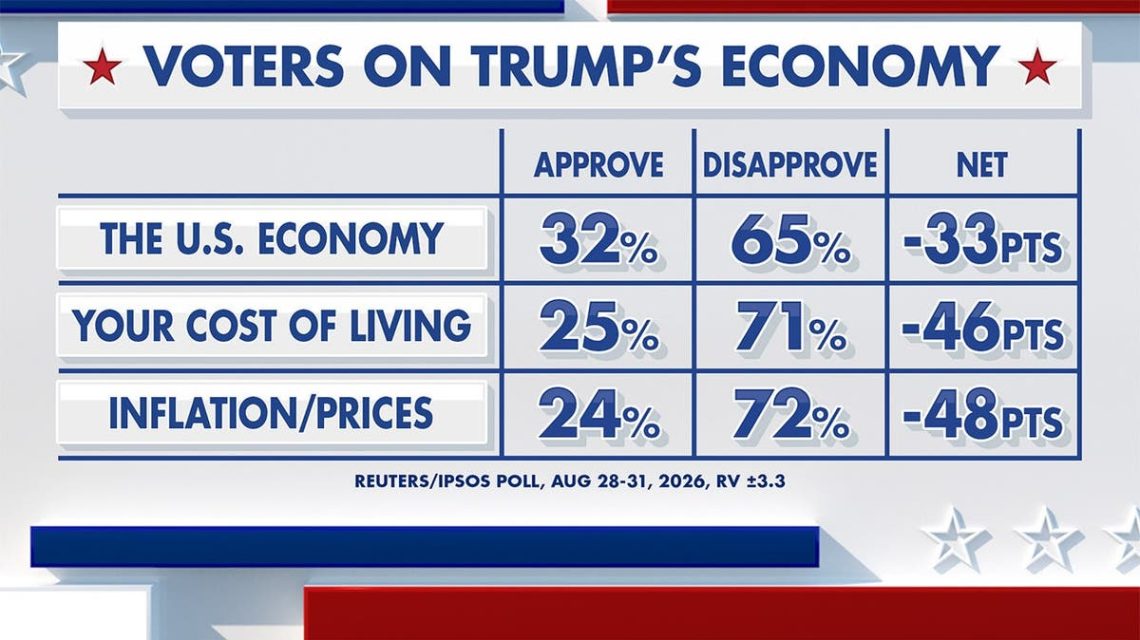
Janelle King, co-chair of Let’s Win for America Action, analyzes a recent Fox News poll showing widespread economic dissatisfaction among voters. King mentions that while President Trump emphasizes ‘Trump accounts’ as long-term benefits, voters are experiencing immediate financial strain. She also expresses concern about the growing influence of the far-left in significant Midwest primaries, noting a trend toward emotional voting.
In eight weeks, millions of Americans will choose their next congressperson. Numerous polls indicate that the economy will significantly influence their decisions. It stands as the top issue for many voters, with a substantial margin. Most Americans are currently dissatisfied with the economic state. Still, that doesn’t complete the picture.
We know from past elections that voters consider a range of issues when voting. The ‘economy’ can mean different things to different people. Optimism alone won’t win votes concerning financial matters. This year, despite dissatisfaction with President Donald Trump’s economy, there’s no overwhelming enthusiasm for the Democratic alternative yet.
Four Rules for the Upcoming Midterms
1. The Economy and Related Issues Are Crucial
The economy’s significance in elections has been a staple since the early ’90s, when Democratic strategist James Carville emphasized the economy’s centrality to campaigns. The economy has consistently ranked within the top three issues throughout the Trump era, including in the last two midterm elections. In those elections, it held primacy for 47% of voters in 2022 and 18% in 2018. In 2018, healthcare (26%) and immigration (23%) ranked higher, coinciding with Republicans losing 42 seats.
Carville also stressed healthcare’s importance, making it one of three rules: ‘don’t forget health care,’ with the others being ‘the economy, stupid’ and ‘change vs more of the same.’
The economy’s impact extends to other major concerns, such as healthcare. However, even a solid economy wasn’t enough to shield the GOP from setbacks. Healthcare ranks close behind the economy in various surveys this year.
2. The Economy’s Varied Meaning for Voters
When pollsters inquire about voter perspectives on the economy, they question the importance of ‘the economy’ or ‘the state of the economy’ and Trump’s effectiveness in handling economic issues. In some respects, Trump has a robust economic record. Recently, the U.S. job market expanded, adding 162,000 jobs, surpassing expectations. The unemployment rate remains steady at 4.1%. The stock market continues its growth amid international tensions and tariff challenges.
These factors contribute to Trump’s overall economic approval ratings holding in the low-to-mid 30s. Yet, when pollsters focus solely on personal economic situations, the outlook is bleaker. A Reuters/Ipsos poll last week showed only 32% approval for Trump’s economic policies, with lower approval on cost of living (25%) and inflation (24%). High gas and food prices are significant factors causing this divide. A strong Democratic result in November will likely correlate with presidential approval ratings in these areas lingering in the mid-20s.
3. Skepticism Toward Economic Optimism
In 2022, President Joe Biden faced similar challenges. The economy was recovering, particularly in terms of unemployment. However, inflation hovered around 8% throughout the year, with gas prices at approximately $3.75 per gallon. The Biden administration continued to promote positive narratives, initially describing inflation as ‘transitory’ and later portraying ‘zero percent inflation’ from one month to another as a success, despite high annual rates.
These messages failed to resonate with voters, resulting in the GOP gaining the House after a net loss of nine Democratic seats, leaving Biden with a net approval rating of -23 points on the economy. Currently, headline inflation is reduced to 3.4%, while gas prices have reached $4.15 per gallon. Trump’s current net approval rating on the economy is -33 points.
The Trump administration appears to follow a familiar strategy. Vice President JD Vance noted gas prices might be higher without Trump’s policies. These claims resemble previous statements from Biden officials. Voters are likely to remain skeptical of such optimistic economic narratives.
4. Economic Discontent and the Lack of Excitement for Alternatives
Despite the economic dissatisfaction, voters are not necessarily more enthusiastic about the Democratic alternatives. While Democrats propose diverse economic solutions, such as ‘Medicare-for-all’ and increased taxes on the wealthy, they also aim to reverse Trump’s policies while maintaining America’s core economic structure. It is unclear if these propositions are unappealing or if the contrast itself is problematic.
The Reuters/Ipsos survey indicated 36% of voters consider Republicans better at handling the economy, with 37% favoring Democrats. The poll has a ±3.3 percentage point margin of error. These figures are not particularly promising for Democrats.
If Republicans maintain stability in the upcoming elections, those results will reflect current dissatisfaction. Current forecasts suggest Democrats lead with 212 House seats to the GOP’s 206, with 17 highly contested seats. On a favorable night, Democrats might secure 229 seats, while a GOP victory could see them holding their current majority.
State Focus: Changes in Missouri and Ohio
Missouri: Redistricting Shifts the Balance
Republican redistricting efforts won gains across the Southeast after a Supreme Court decision narrowed Voting Rights Act protections. In Missouri, redistricting significantly altered Kansas City’s 5th District, represented by Democrat Emanuel Cleaver, to incorporate more rural, White areas.
This change initially moved the district into the GOP’s favor. However, the Missouri Supreme Court blocked using the new districts without voter approval, restoring the previous layout and strengthening the Democratic position.
Missouri has appealed the decision to the U.S. Supreme Court, which may rule swiftly. For now, Cleaver retains the 5th District. Ohio:
Ohio: Emerging Competitiveness and Scandal
In Ohio, races in the 7th, 10th, and 15th Districts are shifting leftward. The 7th District, held by Republican Max Miller, faces increased competition after allegations from Miller’s ex-wife, Emily Moreno, accusing him of abuse. These allegations have made the district highly competitive.
In the 10th and 15th Districts, held by Republicans Mike Turner and Mike Carey, Democrat Sherrod Brown’s strong Senate race performance poses a competitive threat. The districts have shifted from Solid R to Likely R.
Rémy Numa, lead political affairs specialist at Fox News Channel, provides insights into these dynamics. You can follow him on Twitter: @remynuma.
 Democrats Aim for Significant Wins in Ohio Elections
  Democrats’ Prospects in Midterm Elections Improve
  Nebraska Senate Race: Dan Osborn’s Challenge Against Republican Incumbent
  The Intersection of Reality TV and Modern Politics
  Republicans Open to Raising Taxes to Shore Up Social Security
  California’s Electric Vehicle Journey Amid Political Challenges