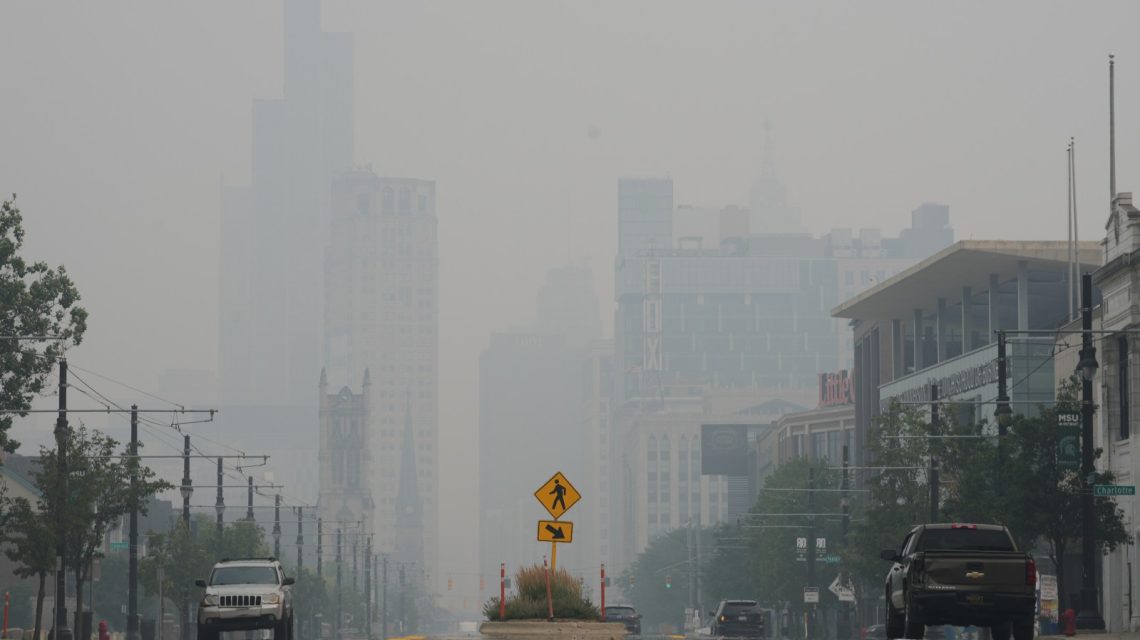
On Friday, three U.S. cities led a global ranking for worst air quality caused by widespread smoke from Canadian wildfires. Detroit’s air quality reached a “very unhealthy” U.S. Air Quality Index (AQI) reading of 240 between 1 and 2 p.m. ET, marking it as the worst among major cities monitored by Swiss air-quality company IQAir. Chicago followed with an “unhealthy” reading of 199, and Washington, D.C., recorded a level of 172. New York City was eighth, with a reading of 131.
Outside the United States, Kinshasa in the Democratic Republic of the Congo registered 186, while Delhi, India, known for high pollution levels, recorded 163. Jakarta, Indonesia, showed a 144 reading, considered “unhealthy for sensitive groups.” New Delhi faces continuous high pollution with an annual PM2.5 average concentration of 99.6 µg/m3, according to IQAir.
The U.S. Environmental Protection Agency explains that µg/m3 measures the mass of pollutants in micrograms within a cubic meter of air.
Why PM2.5 Is a Major Concern
PM2.5 stands out in air quality reports due to its small size and persistence. It emerges from vehicles, industrial activities, wildfires, agricultural burning, and household chores, labeling it as a marker for poor air quality. Its tiny size enables it to infiltrate buildings and penetrate deep into lungs and the bloodstream, increasing health risks. Often listed as the main pollutant, PM2.5 frequently surpasses safety levels, affecting large populations.
The index provides a timely picture of air quality over 100 major cities and shifts with pollution and weather variations. It does not reflect annual averages, with U.S. cities’ high placement driven by immediate effects of wildfire smoke instead of regular air quality levels.
Effects of Canadian Wildfire Smoke on the U.S.
Wildfire smoke from northern Ontario traveled south, affecting the Great Lakes, Midwest, and Northeast, compromising air quality hundreds of miles from the fires. Alerts spanned multiple states, obscuring New York City’s skyline in haze. Local officials advised residents to stay indoors or use high-quality masks outside. New York City canceled outdoor activities, opened cooling centers, and distributed masks amid the combination of heat and smoke posing potential threats.
In Detroit, conditions worsened with AQI readings from 300 to 500 overnight, classified as hazardous due to weak winds trapping smoke at ground level. Warnings indicated continued smoke would reduce visibility in the region.
Dense-smoke advisories covered parts of Lake Huron, Lake St. Clair, and the Michigan waters of Lake Erie, with expected visibility falling to a nautical mile or less. Detroit’s air-quality alert was expected to remain until midnight Friday. A shift to southwest winds Friday night should improve conditions, although ongoing fires in Canada mean changes in wind could introduce more smoke into the U.S.
Choosing the Right Mask for Wildfire Smoke
Health professionals advise using N95 or KN95 respirators during unavoidable exposure to wildfire smoke. Unlike loose face coverings, these masks effectively filter tiny airborne particles when worn properly.
Dr. Tyler Evans, founder of Wellness Equity Alliance, clarified, “The hazard in wildfire smoke is fine microscopic particulate matter. A cloth or surgical mask won’t block these particles.”
Proper N95 or KN95 fit is crucial, preventing air leaks around the edges and ensuring a seal against the face. Limiting outdoor presence and maintaining clean indoor air stay primary defenses. Masks are essential only for unavoidable outdoor activities.
The Public Health Agency of Canada recommends tight-fitting N95, KN95, and KF94 respirators to reduce exposure. These should fit closely over the nose, mouth, and chin without gaps. The agency advises against wearing these while asleep and suggests those unable to remove a mask unaided or experiencing breathing issues not use one.
 Recall of Meat Products from Star Meat Delivery Inc.
  Presley Gerber’s Passing Raises Addiction Recovery Concerns
  Understanding October SNAP Benefits: Payment Dates and Changes
  Cold Weather Alerts and El Niño Influence
  Turning Home Food Waste into Compost: A Guide
  Chicagohenge: When Sunlight Aligns with City Streets