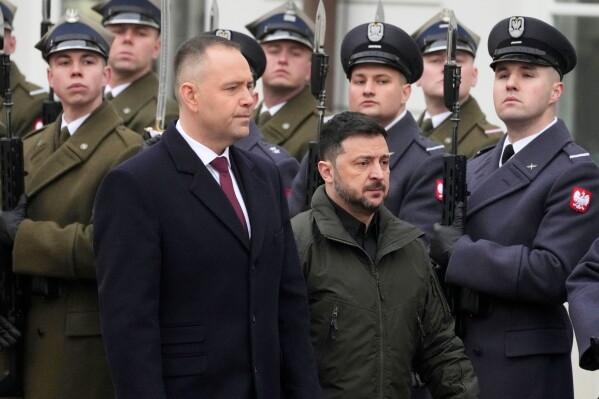
The Ukrainian leader, Volodymyr Zelenskyy, has sent back Poland’s highest state honor amid revived historical disputes between the two countries over events related to World War II. This move by Zelenskyy follows the decision of the Polish president to revoke the award.
Zelenskyy, in a social media post, elaborated that the order had initially been intended for the Ukrainian population and military. Emphasizing respect for Ukraine’s efforts, he stated that he returned the Order to demonstrate the honor Ukrainians merit. Attached to the message were images of the Polish order and a postal receipt indicating its dispatch to Poland’s presidential office.
The Polish presidential decision, led by Karol Nawrocki, arose from Zelenskyy naming a Ukrainian military unit after a paramilitary organization linked to the massacre of Poles during WWII. Prior to this, the award was granted by former President Andrzej Duda in recognition of Zelenskyy’s efforts in enhancing security, resilience, and defending human rights.
On May 26, Zelenskyy announced that a unit within Ukraine’s Special Operations Forces would carry the name of the Ukrainian Insurgent Army (UPA). This group was active in the 1940s and 1950s and is cited for atrocities against Polish citizens during WWII. According to Nawrocki, the UPA remains primarily associated with brutalities against the Polish Republic’s inhabitants.
The Ukrainian decree sparked mixed reactions in Poland, a nation hosting numerous Ukrainian refugees and a key ally in Ukraine’s ongoing conflict with Russia.
While Nawrocki, known for his nationalistic stance, has used anti-Ukrainian sentiments to political advantage, he insists that retracting the honor does not imply decreased support for Ukraine. On the contrary, Zelenskyy acknowledged Ukraine’s gratitude for Polish backing against Russia and expressed willingness to address historical differences.
Kyrylo Budanov from the Ukrainian Presidential Office criticized Nawrocki’s decision as unfriendly to Ukraine. He labeled it a favorable gesture to Russia, which might exploit these tensions. Following this, several Ukrainian officials announced their intent to return Polish state honors.
On social media, Ukraine’s ex-prime minister Arseniy Yatsenyuk contended that the Polish decision was regrettable, countering it with further incorrect actions. The call to bridge these gaps becomes imperative as Poland prepares for an upcoming event focused on Ukraine’s postwar rebuilding, which Zelenskyy intended to attend.
Donald Tusk, Poland’s Prime Minister, who often opposes Nawrocki politically, urged moderation from both leaders. He highlighted that current discord between the nations serves Russia’s interest while unsettling their allies. Tusk stressed the importance of focusing on shared challenges instead.
Zelenskyy rationalized naming the unit after the UPA as a way to revive military traditions and honor its role in defending Ukraine’s sovereignty. The UPA battled for Ukraine’s independence against Nazi and Soviet forces. However, it remains accused of mass killings of Poles, notably in areas now part of modern Ukraine, which the Polish parliament identified as genocide.
Both nations have begun addressing the issue of exhuming Polish war victims from this period. Recent dialogues between the presidents of Poland and Ukraine in Warsaw suggested strides toward historical reconciliation.
Further development on Poland-Ukraine relations and efforts in historical reconciliation will unfold in the coming weeks.
 Twitch Streamer Hasan Piker Discusses Controversial Commentary
  A Shifting Political Landscape: The Decline of Autocratic Power
  Trump Delivers Warning to Iran, Cuba at UN General Assembly
  Lukashenko and Putin’s Unique Relationship and Belarus’ Strategic Role
  Alan Ritchson Faces Backlash Over Political Remarks
  Himalayan Pilgrimage: A Couple’s Narrow Escape and Lingering Questions