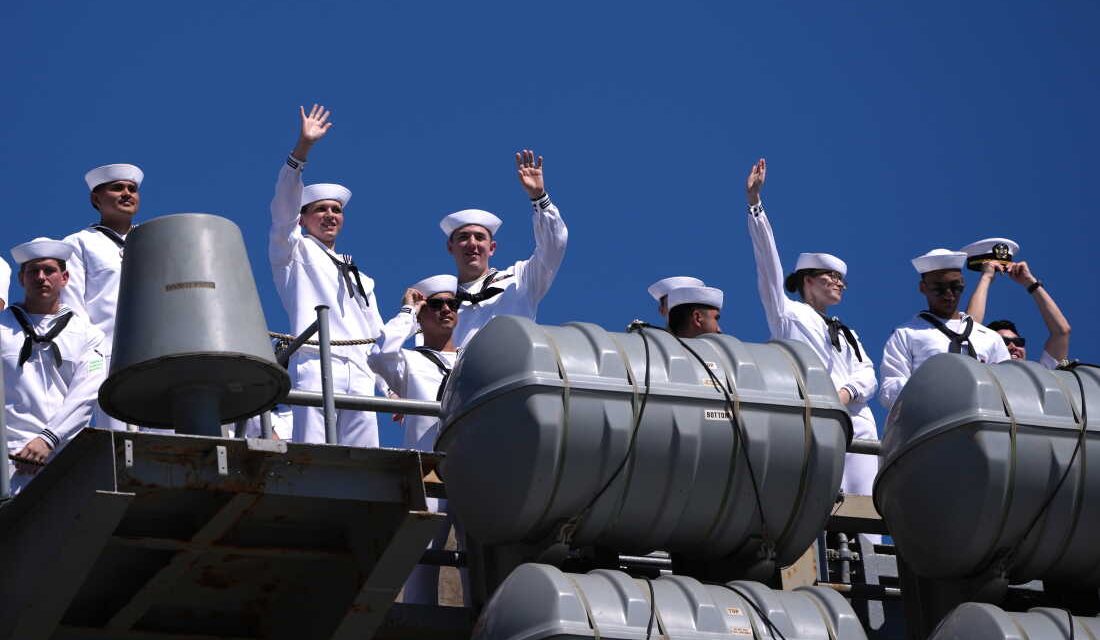
The USS Abraham Lincoln aircraft carrier returned to Naval Air Station North Island in Coronado, California, on October 8, 2026, following a deployment that lasted over 10 months. Thousands of sailors disembarked to jubilant applause, emotional hugs, and tears, marking a significant homecoming. Many were new fathers meeting their children for the first time, having left prior to their birth during a historic deployment associated with the Iran conflict.
During the carrier’s record-holding stint of 265 days at sea without interruption, families experienced emotional challenges due to limited communication. They reported supply shortages and concerns over deteriorating mental health among the sailors. Communication was sporadic, often restricted to infrequent emails or rare calls using WhatsApp.
Abel Ramirez, a 20-year-old sailor, expressed relief over the deployment’s conclusion. He left the ship with a broad smile, thrilled to locate his parents who had journeyed from Texas. “It feels amazing,” Ramirez shared while on his way to meet them, acknowledging moments during the deployment when he doubted returning soon.
Cassity Garduque, age 14, waved eagerly at her mother, who returned the gesture fervently from the ship’s deck. Cassity expressed mixed feelings. “It’s really overwhelming,” she stated upon reuniting with her mom, having missed her presence during her seventh grade and birthday. She looked forward to celebrating together and for her mom to enjoy meals beyond the ship’s offerings.
Capt. Daniel Keeler, the ship’s commander, affirmed that most sailors were on their first deployment. He noted the challenges as typical for such prolonged periods at sea, ensuring the crew had access to four daily meals. “It’s a floating city,” Keeler explained, noting the expected maintenance issues.
The Navy had initially downplayed concerns but later acknowledged some problems. President Donald Trump downplayed the deployment’s duration, suggesting it was insufficiently lengthy. Despite criticisms, Defense Secretary Pete Hegseth visited the ship, awarding the Presidential Unit Citation—reserved for significant combat achievements. He commended the sailors’ resilience.
The Lincoln was one of two carriers enduring extended deployments during the Iran war. Its deployment of 322 days was closely matched to that of USS Gerald R. Ford, which recently completed a 326-day deployment, marking the longest since the Vietnam War. Among those disembarking were numerous new fathers meeting their babies for the first time.
Sailor Kathy Monterrosa, while holding her 6-month-old daughter Sarahi, recounted the difficulties during her husband’s deployment. Emotionally strained by the ship’s challenging conditions, she felt relief upon finally hearing from him and now embraces their reunion.
Other sailors expressed joy and relief. Steven Rivas, holding his 7-month-old daughter, shared his overwhelming emotions. As they docked, seeing family awaiting, he was moved to tears.
Alma Solano Velez mentioned her husband’s craving for home-cooked meals, listing foods such as oxtail and barbecue chicken. He had shared concerns about “the lack of food and showers” aboard. The carrier had seen reduced meal options due to combat operations impacting resupply efforts.
The ship embarked from San Diego in November, reaching the Middle East by January. The crew partook in coordinated airstrikes against Iran by US and Israeli forces in late February. They made a brief stop in Thailand while returning home in September.
Extended periods at sea pressure service members and strain equipment. During this deployment, eight sailors attempted suicide—considered a low figure for a contingent of 6,000 over such duration. According to Secretary Hegseth, the carrier group executed 3,700 combat missions, launched hundreds of missiles, and engaged with numerous war-targets, showcasing the operation’s scope.
In August, the USS George Washington, stationed in Asia, relieved the USS Lincoln in the Middle East, allowing for its return.
 Details Emerge After 6-Year-Old Shoots Teacher at Newport News School
  Downtown Skokie Hotel Project Shows Signs of Progress
  President Trump Urges Minnesotans to Respond to Somali Immigrants
  Higher Federal Benefits for Veterans and Families Expected Next Year
  Public Execution Suggested for Fort Hood Shooter
  Completion of Water Main Replacement Celebrated in Hebron