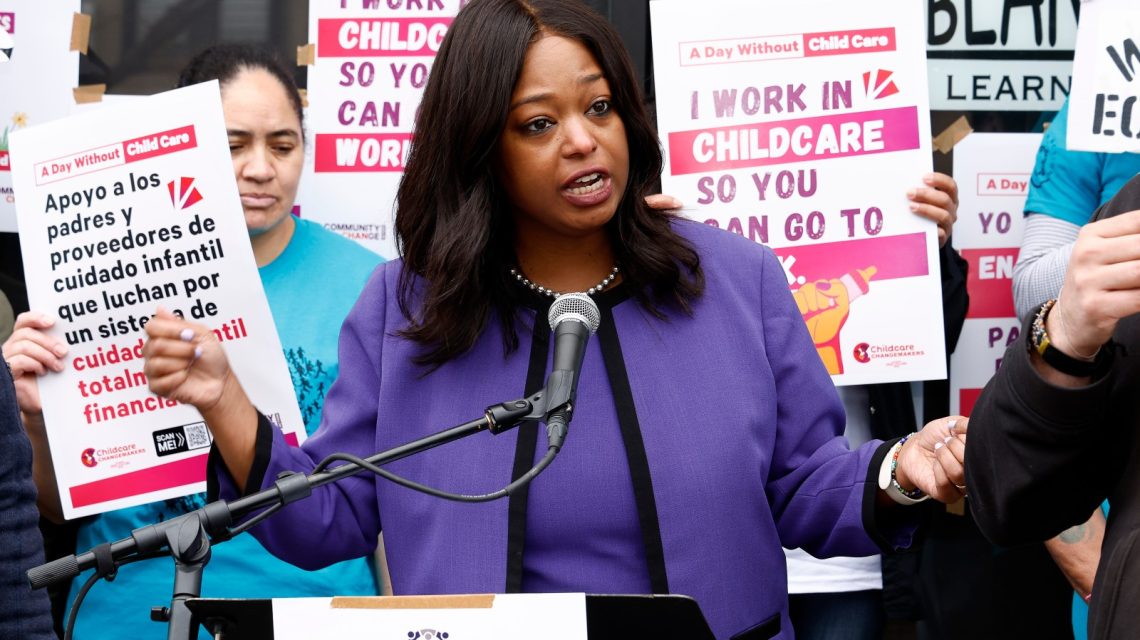
President Donald Trump has suggested that the federal government might “take back” Washington, D.C. This suggestion comes in response to the lead of Janeese Lewis George, a democratic socialist, in polls for the Democratic primary for the mayoral race. Trump’s relationship with leaders of Democratic strongholds has been tense during his second term, amid disagreements on issues such as immigration and public safety.
Washington, D.C. is predominantly liberal, contributing less than 7% of its votes to Trump in the 2024 election. Hence, the winner of the Democratic primary is likely to win the general election. After a reporter asked Trump about Lewis George’s candidacy, comparing her to New York City Mayor Zohran Mamdani, Trump stated he “wouldn’t like it” if she won the election.
“Maybe we take back Washington and run it on a federal basis,” Trump said. “We won’t put up with it. We’re not going to lose our businesses. By the way, Washington now is a safe, beautiful place.”
As Lewis George maintains her lead in polls and prediction markets, Newsweek sought comments from leading mayoral candidates. These candidates expressed their opposition to Trump’s proposal.
DC Mayoral Candidates Rebuke Trump Remarks
Several candidates from the D.C. mayoral race voiced opposition to Trump’s comments. Rini Sampath, a cybersecurity director, expressed surprise at Trump’s remarks in an interview. “We all knew something like this was coming,” she stated, emphasizing the need to resist federal interference in local elections. Sampath pointed out that D.C. is a “majority-Black city that has been denied full democracy for decades.”
Ernest Johnson, CEO and chairman of the nonprofit Friends of the Frank Reeves Center, remarked that Trump’s comments stress the importance of defending Home Rule and local governance. He criticized local leaders for not forcefully protecting D.C.’s interests, mentioning Lewis George and Kenyan McDuffie specifically.
Hope Solomon, with a background in national security, emphasized the necessity of working with the current administration. She criticized opponents for refusing to engage in dialogue, noting that the city faces significant budget challenges.
Janeese Lewis George’s Polling Lead
Two polls have been released for the Democratic primary, both indicating Lewis George’s lead. This year, the primary will use a ranked-choice system, requiring voters to rank candidates by preference. If no one achieves 50%, the candidate with the least votes is eliminated, and votes are redistributed based on second choices until a majority is reached.
Poll Results:
- The Washington Post/George Mason University (May 27-June 1; 836 likely Democratic voters)
Janeese Lewis George: 36%
Kenyan McDuffie: 25%
Vincent Orange: 4%
Gary Goodweather: 3%
Rini Sampath: 3%
Ernest Johnson: 1%
Hope Solomon: 1% - City Cast/TrueDot (May 12-17; 487 registered Democrats)
Janeese Lewis George: 39%
Kenyan McDuffie: 34%
Gary Goodweather: 7%
Vincent Orange: 5%
Rini Sampath: 4%
Ernest Johnson: 3%
Hope Solomon: 2%
Due to the district’s strong Democratic inclination, the general election is expected to be straightforward.
What Do Prediction Markets Show?
Lewis George also leads prediction markets, with an 89% chance on Kalshi and an 87% chance on Polymarket. Prediction markets let traders buy and sell contracts tied to political outcomes, offering real-time probability estimates based on various factors. These markets indicate current trader sentiment but are not always accurate predictors of outcomes.
Who Is Janeese Lewis George?
Janeese Lewis George serves on the Council of the District of Columbia. She holds a law degree from Howard University and has experience as a prosecutor in Philadelphia. Elected to the council in 2020, she identifies as a democratic socialist with backing from the local Democratic Socialists of America chapter. Her election would mark the city’s first democratic socialist mayor.
Trump Has Suggested Revoking D.C. Home Rule Before
Trump has previously used similar language regarding D.C.’s home rule, citing crime as a significant concern. In August 2025, he noted that federal control might be necessary if the city did not improve its situation. The Home Rule Act, signed in 1973 by President Richard Nixon, allows D.C. residents to elect local leaders, but Congress still holds considerable power over local governance. Any repeal of this agreement would require Congressional approval. Legislation to revoke the home rule agreement has been proposed but has not gained traction.
 Trump Delivers Warning to Iran, Cuba at UN General Assembly
  Trump Delivers Stern UN Speech on Iran, AI, and Global Security
  Lukashenko and Putin’s Unique Relationship and Belarus’ Strategic Role
  Harris Discusses Potential 2028 Presidential Run
  Far-Left Groups Allegedly Organize Protests in Austin
  Michigan Senate Nominee Abdul El-Sayed Criticized for Remarks on Reproductive Rights