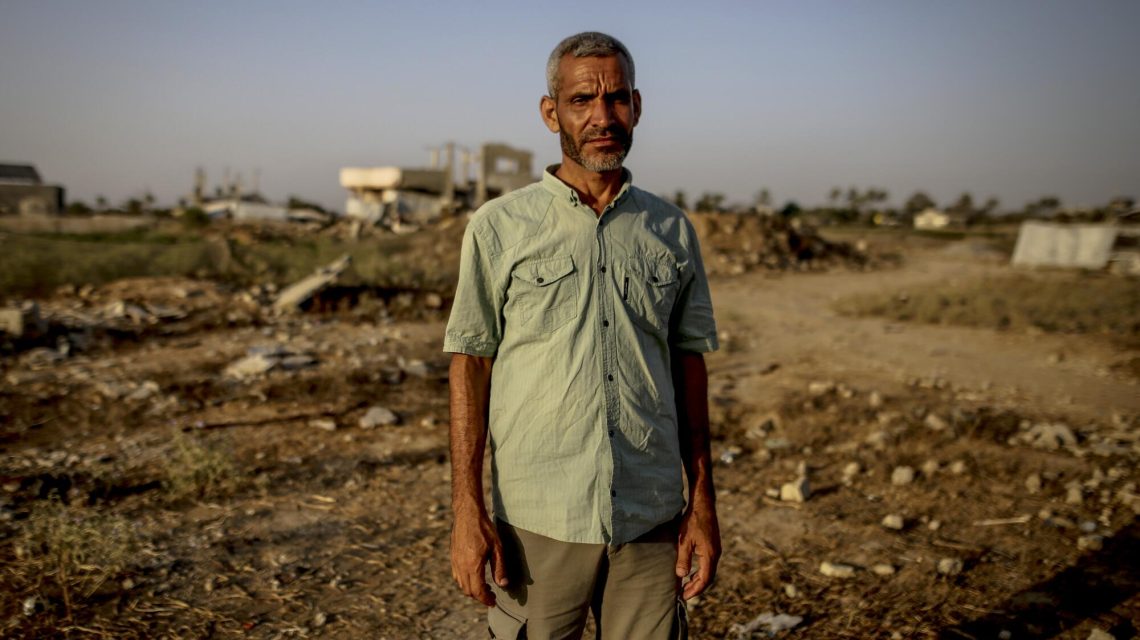
The Yellow Line, a stark demarcation marking the boundaries of Israel’s military zone in Gaza, has inched closer to Ashraf Al-Louh’s makeshift shelter over the last three months. For Al-Louh, a resident of the city of Deir al Balah in the Gaza Strip, its advance signals the urgent need to relocate, as has been the case for many others in the area.
The Yellow Line, characterized by large yellow-painted cement blocks, indicates the limit of Israel’s military zone. Its encroachment has forced numerous residents to flee their homes, joining the exodus from this war-torn neighborhood. A symbol of division, the Yellow Line emerged in October 2025 following a truce brokered by the Trump administration between Israel and Hamas, intended to divide Gaza into two distinct zones.
The zone’s progression has displaced thousands, reducing their living space to ever-shrinking borders marked by severe living conditions. Israel controls approximately 64% of Gaza, with an expanded restricted territory called the Orange Zone where strict regulations block aid groups from easily delivering supplies.
Al-Louh and his family, along with many others, have endured displacement multiple times. He, his wife, and their six children reside under the remnants of a demolished building, apprehensively watching as the latest Israeli encroachment approaches.
The threat is tangible, with the U.N. reporting 196 Palestinian deaths near the Yellow Line since the ceasefire’s inception. Despite assurances of defense, Israeli forces have consistently engaged with deadly force.
Farmers in the region, like Ahmed Al-Louh, are aware of the dwindling time they have before further displacement. They harvest crops prematurely, fearing another extension of the zone could prevent future access.
The conditions are exacerbated by continuous Israeli attacks, as reported by more than 1,230 Palestinian deaths and destruction of countless buildings since the ceasefire. Israel argues these are measures to prevent Hamas’ reformation; however, many residents view the erection of barriers and earthworks that stretch 25 miles as indicative of a prolonged military presence.
Despite announcements from Hamas alongside the Board of Peace to commence disarmament, Israeli Prime Minister Benjamin Netanyahu has made clear that Israeli forces will not withdraw until full disarmament is achieved.
Al-Louh remains vigilant under the shadow of sporadic gunfire and drone surveillance, aware of the cycle that precedes further advancement of the line. The imminent danger is a reminder of yet another push westward, which would render more areas inaccessible.
Retired land surveyor Jamal Abu Miri has witnessed the Yellow Line encroach upon a lifetime’s work. Decades of savings invested in property and family inheritance have vanished under the line’s relentless advancement, leaving him and his family in displacement camps.
In a landscape defined by conflict and loss, the residents of Deir al Balah, like Al-Louh and Abu Miri, brace themselves for yet another inevitable departure. They live with the constant anticipation of the next move, knowing their existence hangs at the edge of the Yellow Line.
 Iran War Debate Among Senate Nominees
  Papal Mass in Paris Draws Massive Crowd
  Xi Jinping’s State Visit to Washington: Diplomacy and Pageantry
  Israeli Ambassador’s Viral Video Reaches Millions in Iran
  Trump Discusses Ukraine-Russia War and Patriot Missile Agreements
  Tony Blair Discusses Europe’s Alliance with the U.S.