
The administration’s export control order on June 12 affected Anthropic, leading to the recall of its key AI models, Mythos 5 and Fable 5. Allegedly, officials perceived these models as potential tools for attacks on U.S. critical infrastructure. As a result, the order mandated Anthropic to withdraw the models from foreign access, including foreigners within the U.S.
Unable to restrict access based on nationality, Anthropic complied by removing public availability of their models. Soon after, OpenAI similarly limited the release of its GPT-5.6 model. This limitation came after concerns over a possible export ban surfaced.
Weeks later, the administration partially lifted restrictions on Mythos 5, permitting its release to select U.S. users. On June 30, it informed Anthropic they no longer required a license for Mythos and Fable. Anthropic still restricted Mythos to specific U.S. organizations, while making Fable widely available. OpenAI received approval for a broad release of GPT-5.6 on July 8.
The measures highlight the role of export control orders in national security and foreign policy. Initially, the government requested Anthropic’s cooperation to address security issues. An official remarked that export controls were a measure of ‘last resort,’ with Anthropic given just 90 minutes to comply. This action resulted in what some call a de facto licensing regime, with ongoing concerns about future model access.
Martin Chorzempa from the Peterson Institute warned of potential government shutoffs to future model access. Despite access restoration to models, the administration stressed its right to reinstate licensing requirements. Jessica Tillipman, a scholar in government procurement law, criticized the hasty decision-making process over the security risks posed by Anthropic’s models.
Law professor Alan Z. Rozenshtein highlighted the authority granted by the Export Control Reform Act of 2018. This act allows secret, binding instructions for requiring export licenses, bypassing public notice, and legal challenges under the Administrative Procedure Act. The current situation, with its arbitrary control, was designed to be prevented by these procedures.
This unchecked authority raises concerns for U.S. tech companies abroad, now seen as unreliable partners. The situation has been likened to America’s Strait of Hormuz by a French political figure. The ongoing lack of transparency and accountability in export control decisions puts American AI companies at risk.
As Congress deliberates on AI regulation to mitigate risks, reforming export control laws is becoming imperative. Implementing procedures similar to those in the National Highway and Traffic Safety Administration or the Consumer Product Safety Commission could offer a model for responsible regulation. Additionally, ensuring public justification and review for government actions can prevent arbitrary enforcement.
The current state of affairs demonstrates a need for legislative action. The unequivocal need for reform is evident, and Congress should promptly address these concerns for the benefit of the AI industry and national interests.
Mark MacCarthy authored this analysis. He serves as an adjunct professor at Georgetown University and holds fellowships at the Institute for Technology Law and Policy at Georgetown Law and the Brookings Institution.
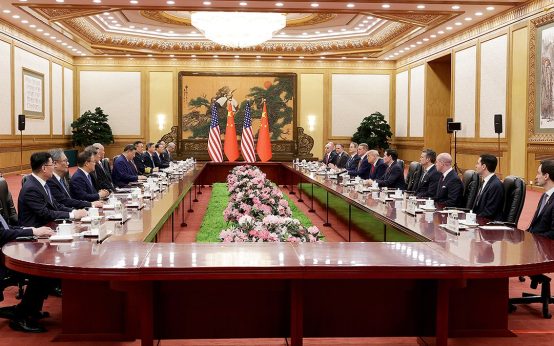 U.S.-China Tech Rivalry and the Battle for AI Dominance
  Protecting Your Finances from Increasing Cyber Threats
  Nvidia CEO Jensen Huang Talks AI, U.S.-China Competition, and Data Centers
  Legal Battles Over Sports Betting and Addiction Claims
  Concerns About Rapid Advancements in Artificial Intelligence
  Leading AI Companies Face Antitrust Lawsuit for Alleged Coordination