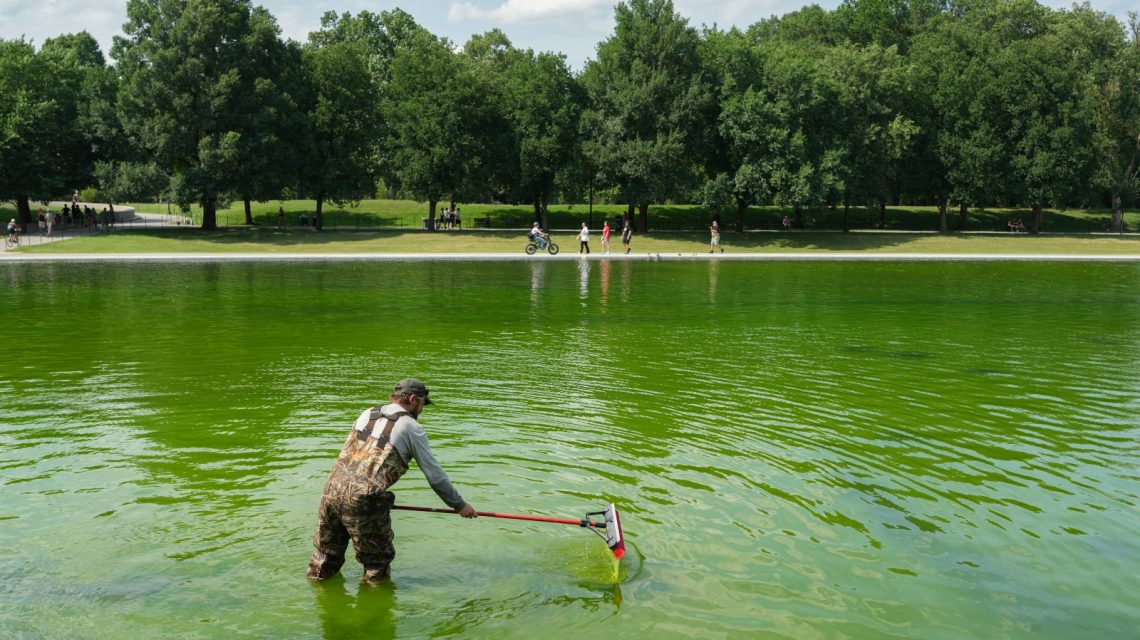
The Lincoln Memorial Reflecting Pool has recently turned an unexpected green, just days after reopening. Footage showed workers addressing this issue by pouring hydrogen peroxide into the water to combat a rapid algal bloom. This effort follows a major renovation that aimed for a deeper blue finish, raising concerns about what went wrong and the safety of the chemical treatment.
Why the Reflecting Pool Turned Green
Algal blooms in the reflecting pool are not new occurrences. The shallow, slow-moving water, partly fed by the nearby Tidal Basin, provides ideal conditions for algae growth. However, the speed of this recent bloom has raised eyebrows.
Draining, repainting, and refilling the pool occurred over a tight schedule, which may have led to residual algae in the pipes and systems. Introduction of warm water during early summer could have further facilitated algal growth. Christopher Lowe, a marine biologist at Swansea University, explained that algae can re-enter water systems through many paths, including birds carrying them. Algae need light and nutrients to thrive, conditions readily available at outdoor sites like the National Mall.
The Use of Hydrogen Peroxide
Hydrogen peroxide is a common agent in water treatment, used to break down algae and other organic matter. Officials describe it as “milder” than chlorine, fitting for environments with wildlife. Nanobubble ozone systems are used alongside to eliminate pathogens.
Treating a pool containing approximately 6.5 million gallons of water is a logistical challenge. Lowe noted that hydrogen peroxide helps by both killing and bleaching algae, improving the pool’s appearance.
Problems with Hydrogen Peroxide
The use of hydrogen peroxide has sparked debate about its efficacy. Workers are seen manually pouring containers of hydrogen peroxide into the pool. Experts suggest treating such a large body needs larger quantities and careful calibration.
1. Scale and Efficacy
The pool’s volume raises questions about manual dosing’s effectiveness. Dosing in open systems like this must consider concentration, not just volume.
2. Cost vs. Short-Term Solution
Hydrogen peroxide acts as a temporary solution, breaking down quickly into oxygen and water. This raises cost concerns, as repeated treatments might run expensive compared to long-term strategies on nutrient control and circulation.
3. Design Trade-Offs: Still vs. Movement
The pool’s design requires a balance between maintaining its mirror-like surface and controlling algae. Warm, still water encourages algae, yet increased circulation could spoil reflections. The recent renovation potentially changed how heat and nutrients affect the pool, accelerating algal conditions.
4. Environmental Impact
The reflecting pool is not isolated. Birds, debris, and runoff interact with the water daily. While the hydrogen peroxide treatment is wildlife-safe, continual chemical use could make the pool’s environment inhospitable to most life. Lowe remarked that even a sterilized pool would soon host algae again due to external factors.
Hydrogen peroxide’s impact is minimal, breaking down into non-toxic substances, but could eventually create an ecological void in the pool’s water.
 The Discovery of Incendiamoeba cascadensis: A Fire Amoeba
  Archaeological Discovery in Germany: Largest Hoard of Roman Coins Found
  Cold Weather Alerts and El Niño Influence
  Turning Home Food Waste into Compost: A Guide
  Chicagohenge: When Sunlight Aligns with City Streets
  Fat Bear Week 2026: A Look at the Contest and Its Competitors