In 1909, architect Daniel Burnham introduced his groundbreaking Plan of Chicago. His vision significantly shaped the city’s development and its park system, creating a magnificent open lakefront. More than a century later, World Business Chicago hosted the “Horizon Lines” design contest, hoping to discover the next transformative idea for the city’s future.
Nearly 200 participants submitted ambitious proposals for Chicago’s look in 2050. Ideas ranged from creating islands in Lake Michigan to installing themed public toilets across the city. Ultimately, six concepts emerged as finalists, competing for a $5,000 prize and a chance to be developed further.
Phil Clement, CEO of World Business Chicago, remarked on the ambition of these ideas. The finalists’ work, on display at the Chicago Cultural Center throughout the summer, invites the public to engage and express their preferences.
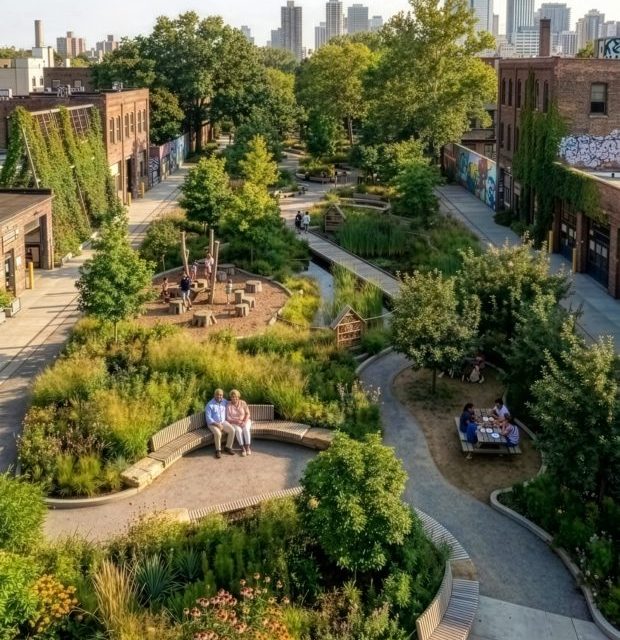
Green City Rising: Chicago’s Living Network of Neighborhood Arboreta
The Morton Arboretum proposes reconnecting Chicago with its green roots. By establishing mini-forests across city neighborhoods, they aim to revitalize the “Urbs in Horto” motto, meaning city in a garden. This involves expanding the forest canopy and reducing dependence on concrete structures.
“We have a lot of concrete buildings; this would bring back the essence of Chicago’s natural past,” commented Elle Rampel, World Business Chicago’s chief of staff.
The Third Frontage Initiative
This initiative envisions transforming Chicago’s 1,900-mile alley network into vibrant neighborhood spaces. Architecture firms Gensler and Adrian Smith + Gordon Gill propose converting these alleys into active streetscapes with housing and green infrastructure.
“Chicago’s next great public realm may already exist, hidden in plain sight,” wrote authors Tian Ouyang and Yibin Yang.
Repairing the Scars of the Interstate Highway Era
The Metropolitan Planning Council seeks to cover the Dan Ryan and Eisenhower expressways with green spaces. This concept turns highways into subterranean tunnels, allowing the creation of pedestrian-friendly parkways above, similar to Boston’s Big Dig project.
Wonderways: Reimagining Chicago’s Boulevards
Design firm MKSK proposes transforming Chicago’s historic boulevards into ecological and social havens. Enhancements include expanded tree canopies, restored prairies, and recreational trails, emphasizing nature’s presence throughout the city.
AgriFlats
Wheeler Kearns Architects suggest converting food deserts into urban agricultural zones. This proposal includes interconnected greenhouses with living quarters for growers, fostering community and supplying pesticide-free produce citywide.
Re-Loop, The Living Mile
The Re-Loop Vision Coalition imagines a South Side attraction built from recycled materials. Featuring sculptures from CTA rail steel and stalls for local businesses, this district aims to engage tourists and locals alike.
The winning concept will receive $5,000, with other finalists awarded $1,000 each. Their designs will also gain early engagement opportunities with city planning officials. An exhibit at the Cultural Center runs through September 20, showcasing innovative ideas to redefine Chicago. Notable submissions include a towering Buckingham Fountain and artistic public toilets, each reflecting Chicago’s “no small plans” legacy.
 Florida Startup Develops AI Bot to Reduce Construction Dispute Costs
  Tuya Smart’s Doova Robot: Enhancing Senior Care at Home
  Growing Concerns Over AI in the Tech Community
  Challenges in Robot Food Delivery: A Day in Washington, D.C.
  Understanding Google’s New Gmail Verified Sender Program for Political Emails
  FAA Tests Elroy Air’s Chaparral Drone for Rural Delivery Solutions