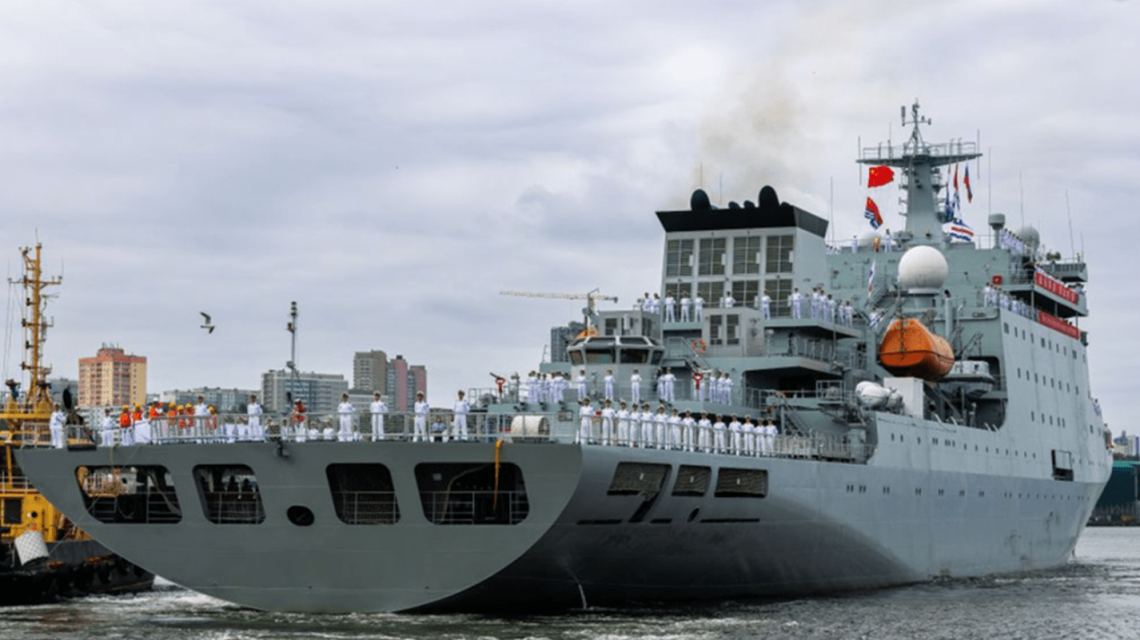
A Chinese naval flotilla reached Vladivostok, Russia’s far eastern port, on Tuesday for a four-day session of training and exchanges. This visit highlights the growing military collaboration between Beijing and Moscow amid escalating tensions with the United States and its partners in the western Pacific. The People’s Liberation Army Navy’s Task Force 83, including the training ship Qi Jiguang and the amphibious dock landing ship Kunlunshan, arrived at Vladivostok, the headquarters of Russia’s Pacific Fleet, following an invitation from the Russian Navy. Images from the Chinese state media outlet Xinhua depicted flag-waving spectators welcoming the vessels along the waterfront.
While China maintains a neutral stance on Russia’s conflict in Ukraine, it has supported Russia’s sanctions-affected economy through robust cross-border trade. This includes dual-use exports and increased purchases of discounted Russian oil and gas. The U.S. and European nations consistently describe China as a “decisive enabler” of Russian President Vladimir Putin’s war efforts. Last month, Putin and Chinese leader Xi Jinping reinforced their strategic partnership during the Russian leader’s visit to Beijing, with commitments to deepen cooperation across defense, energy, and technology sectors.
“The Chinese and Russian militaries will earnestly implement the consensus reached by the two heads of state and continue to expand practical cooperation in various fields,” announced China’s Defense Ministry in a statement released Monday, just before Qi Jiguang and Kunlunshan reached Vladivostok. Newsweek reached out to the Russian foreign ministry and the Pentagon for comments via email.
Naval Cooperation
The mission represents a “long-distance sea internship,” where Chinese sailors will exchange experiences with Russian naval officers. Over recent years, the two nations have steadily fortified security ties, marked by increased joint air and naval exercises. Although 2025 saw a decrease in the number of joint drills compared to 2024, they conducted their inaugural joint submarine exercise, as reported by the Center for Strategic and International Studies.
According to a June analysis by the Congressional Research Service, “Russia views its navy as central to its great power aspirations, both globally and in the Asia-Pacific region. The importance of Russia’s navy may be one reason why Russia-PRC naval exercises and patrols have been more extensive than comparable ground military exercises, indicating a higher level of familiarity and trust among naval partners.”
U.S. and Allied Concerns
The U.S. Coast Guard has voiced concerns about a rise in Chinese and Russian patrols near U.S. territory, particularly around Alaska. These military operations, whether independent or coordinated, have also caused unease in Japan and South Korea, two of Washington’s Northeast Asian allies.
In December, Chinese and Russian bombers executed a joint patrol over the Sea of Japan and international waters between Japan’s Okinawa and Miyako islands, prompting the Japanese Air Self-Defense Force to deploy fighter jets. Japanese Defense Minister Shinjiro Koizumi remarked that the operation aimed to demonstrate force against Japan, raising significant national security concerns.
Although Beijing and Moscow do not have a formal military alliance, both nations are united in challenging the established U.S. military dominance and advocating for a more multipolar international structure.
 Trump Delivers Warning to Iran, Cuba at UN General Assembly
  Trump Delivers Stern UN Speech on Iran, AI, and Global Security
  Lukashenko and Putin’s Unique Relationship and Belarus’ Strategic Role
  Harris Discusses Potential 2028 Presidential Run
  Far-Left Groups Allegedly Organize Protests in Austin
  Michigan Senate Nominee Abdul El-Sayed Criticized for Remarks on Reproductive Rights