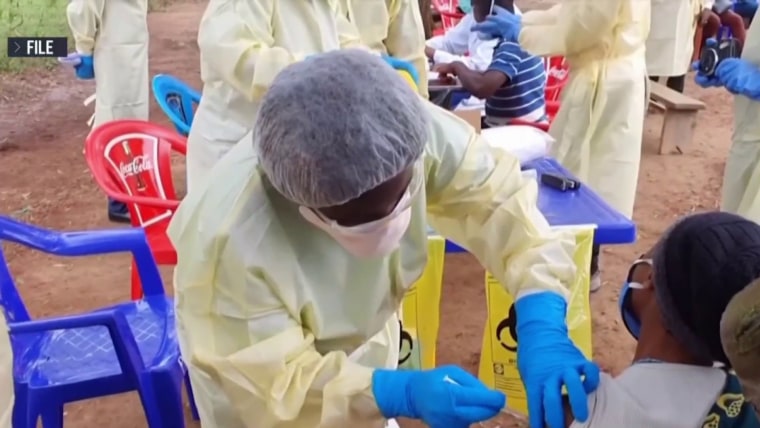
Until last year, the U.S. Agency for International Development (USAID) played a crucial role in responding to Ebola outbreaks. Following recent changes, former federal employees describe the current U.S. response as slow and disjointed. The Trump administration significantly reduced USAID’s presence, reallocating approximately 1,000 programs to the State Department and laying off many staff members.
Ex-officials from USAID, the Centers for Disease Control and Prevention (CDC), the National Institutes of Health (NIH), and the White House suggested that, had USAID remained intact, resources might have helped contain the current Ebola outbreak. Identified in Congo last week, Ebola was likely spreading undetected for weeks. As of Wednesday, the World Health Organization (WHO) reported 139 suspected deaths and 600 cases, with true figures potentially higher.
Nicholas Enrich, former acting assistant administrator for global health at USAID, emphasized the lost speed in response efforts. USAID programs, he said, could have expedited virus detection in Congo, distributed personal protective equipment (PPE) to hospitals, and employed local health workers for screening and contact tracing. Enrich watched these systems unravel as the Trump administration scaled back foreign aid in 2025.
Dr. Daniel Bausch, visiting faculty at the Geneva Graduate Institute, described how community health workers, once key in past outbreaks, had to find other employment, losing trained personnel. The International Rescue Committee (IRC), a previous USAID contractor, noted that U.S. funding cuts forced it to reduce operations in Ituri, the outbreak’s epicenter. This included scaling back surveillance and sanitation efforts.
Today many facilities in affected areas are operating without basic protective supplies,said Heather Reoch Kerr, IRC’s Congo country director.
The State Department asserts these changes haven’t hindered Ebola response capabilities. They announced $23 million in foreign aid to support surveillance, laboratory capacity, and clinical case management. Plans to fund up to 50 clinics for emergency screening and isolation were also revealed.
Dr. David Heymann from the London School of Hygiene & Tropical Medicine pointed to a lack of international collaboration as the core issue, not funding. The U.S. withdrew from the WHO, accused by Trump of Covid pandemic mismanagement. The WHO plays a role in international coordination and logistical support during outbreaks.
With USAID’s reduced presence, the CDC has increased its role. Dr. Satish Pillai from the CDC indicated ongoing efforts in Congo and Uganda, including surveillance and PPE distribution. Yet, Enrich stressed that the CDC excels in providing technical expertise, not broad coordination.
Bausch expressed concern that CDC staff lack local knowledge and experience. An anonymous CDC official noted security challenges in Congo complicating staff deployment.
An early case on April 24 involved a health worker with Ebola-like symptoms. However, local officials did not confirm the virus strain until three weeks later, identifying it as the Bundibugyo virus. Issues with sample testing and logistics delayed analysis and response.
Many hospitals in Congo and Uganda still await necessary resources. Dr. Herbert Luswata at Bwera Hospital in Uganda noted a shortage of PPE and healthcare workers, highlighting the inadequate response speed for an epidemic like Ebola.
 Trump Administration’s Plan to Resettle Afrikaners as Refugees
  Trump’s Vision on Iran, AI, and Global Security at the UN
  Legal Challenges Arise Over GLP-1 Receptor Agonists and Vision Loss Risks
  States Move to Restrict Tianeptine Amid Growing Concerns
  Lithuanian Leader Seeks U.S. Military Commitment Amid Rising Russian Threats
  Italian PM Giorgia Meloni Skips UN General Assembly Amid Growing Tensions