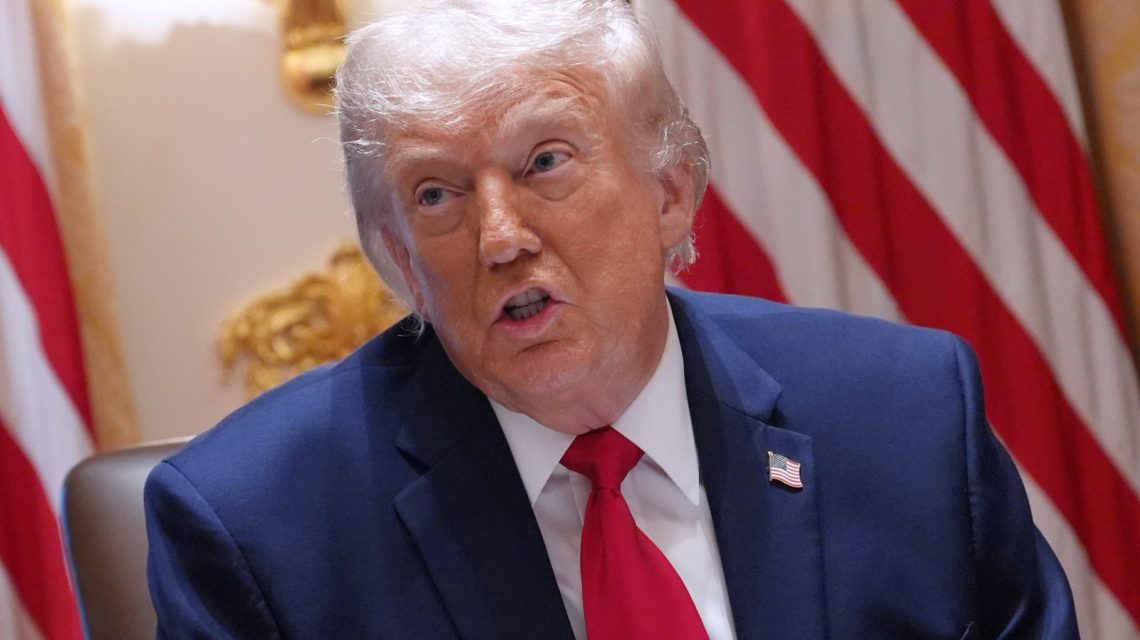
President Donald Trump has expressed strong criticism of the Supreme Court regarding its handling of his attempt to limit birthright citizenship. He described the legal system as ‘rigged’ and indicated that the Supreme Court might reject his executive order, which is approaching a final decision phase.
In a post on Truth Social, Trump stated, ‘The court system is RIGGED, no different than our Political System is RIGGED, and the people of our Country know it. That is why I was overwhelmingly elected President, in Record Numbers, and will FIGHT, FIGHT, FIGHT!’
The Supreme Court is currently reviewing several consolidated cases contesting Trump’s 2025 executive order. This order aims to reduce birthright citizenship protections under the 14th Amendment, proposing that being born on U.S. soil does not guarantee U.S. citizenship.
Newsweek has reached out to the Supreme Court for comment outside regular hours.
Trump Targets Judge and His Wife
In the same post, Trump criticized U.S. District Judge Christopher Cooper, who ruled against the administration in a separate case involving the Kennedy Center. Cooper blocked efforts to rename it the “Trump Kennedy Center” and stopped renovations, citing unlawful actions by the board.
Trump also targeted Cooper’s wife, Amy Jeffress, labeling her as an ‘anti-Trump Hater.’ Jeffress is a partner at the law firm Hecker Fink and has represented Lisa Page, a former FBI lawyer in litigation linked to the Trump administration. She also served as a legal adviser to the committee investigating the January 6 Capitol events, according to Politico.
In 2025, Trump restructured the Kennedy Center board, appointing allies such as second lady Usha Vance, Deputy Chief of Staff Dan Scavino, and Chief of Staff Susie Wiles, as reported by Forbes.
Newsweek contacted Jeffress for comment outside regular working hours.
Updates on Birthright Citizenship Case
Trump’s executive order from 2025, ‘Protecting the Meaning and Value of American Citizenship,’ aims to modify the 14th Amendment and withhold automatic citizenship from children of specific immigrants and visitors. Citizenship would be granted only if one parent is a U.S. citizen or a lawful permanent resident.
The administration argues that the term “subject to the jurisdiction thereof” excludes children of undocumented immigrants and some temporary visa holders. This stance has led to numerous lawsuits from states and civil rights organizations. Ten cases have been consolidated into three significant challenges originating from Massachusetts, Maryland, and Washington.
The Supreme Court has agreed to hear the case, already holding oral arguments. A decision is expected later this term.
Views from Supreme Court Justices
During oral arguments, justices from both political affiliations voiced doubts about narrowing birthright citizenship. Chief Justice John Roberts questioned whether the government’s reference to narrow historical exceptions can realistically extend to large immigrant groups. He noted some examples as ‘very quirky,’ as reported by Axios.
Roberts also addressed Solicitor General D. John Sauer’s concerns about evolving global travel facilitating birthright citizenship manipulation, noting that ‘it is the same Constitution,’ according to Time.
Justices Neil Gorsuch, Brett Kavanaugh, and Amy Coney Barrett also scrutinized the historical and legal justifications for limiting birthright citizenship, identifying gaps in the government’s argument.
 Michigan Senate Nominee Abdul El-Sayed Criticized for Remarks on Reproductive Rights
  Poll Reveals Voter Preferences Between Socialist Democrats and MAGA Republicans
  Challenges of Electing a Female President: Insights from ‘The View’
  Upcoming Concerns and Influence in Health Politics
  Rep. Donalds Distances Himself from Trump as Florida Governor Race Tightens
  Controversy Surrounds President Trump’s Proposed D.C. Arch